
Environmental law for CLAT PG rests on a handful of judgments that every aspirant must know cold. Part 1 covered the foundational trilogy. This part moves into institutional mechanisms, the doctrine of sustainable development, and the role of the National Green Tribunal. Together, these cases explain how Indian courts balance ecology against economic growth and how specialised tribunals now share that burden.
Procedural
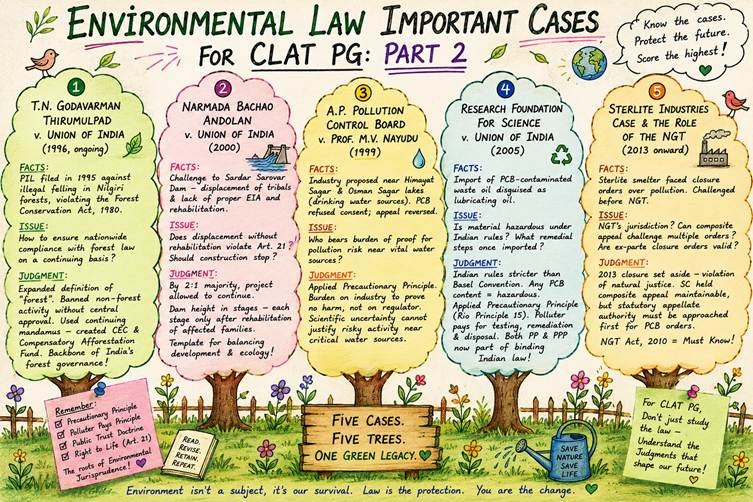
T.N. Godavarman Thirumulpad v. Union of India AIR 1997 SUPREME COURT 1228
Facts:
The case began in 1995 when T.N. Godavarman Thirumulpad filed a writ petition to stop illegal timber felling in the Nilgiri forests of Tamil Nadu. He argued that this activity violated Section 2 of the Forest Conservation Act, 1980, which bars non-forestry use of forest land without central government approval.
Issues:
- What the word “forest” actually meant under Section 2 of the Act, since state governments were applying widely different definitions to permit non-forest activity.
- How to supervise compliance with forest law on a continuing, nationwide basis rather than through a single, final order disposing of the petition.
Judgement:
The Supreme Court found that the problem was not confined to one region. Forest destruction was occurring across the country under a narrow, inconsistent understanding of what counted as a “forest.”
- In its order of 12 December 1996, the Court expanded the definition of “forest” under the Forest Conservation Act to include any area recorded as forest in government records, regardless of ownership or classification.
- It banned non-forest activity in such areas without prior central approval and kept the matter open through what came to be called continuing mandamus.
- This device let the Court issue successive directions over the years, including the creation of the Central Empowered Committee and the Compensatory Afforestation Fund, making Godavarman the backbone of India’s forest governance framework.
Sustainable Development
Narmada Bachao Andolan v. Union of India AIR 2000 SUPREME COURT 3751
Facts:
The Sardar Sarovar Dam project on the Narmada River aimed to supply irrigation, drinking water, and power to Gujarat, Madhya Pradesh, Maharashtra, and Rajasthan. The Narmada Bachao Andolan, led by Medha Patkar, challenged the project in 1994, arguing that it would displace large tribal and rural populations without adequate rehabilitation and without a proper environmental impact assessment.
The petitioners contended that forced displacement without fair resettlement violated the right to life under Article 21. They also argued that the environmental clearance granted in 1987 was incomplete and that construction should stop pending fresh studies. The Union of India and the concerned states responded that the project served vital public needs and that rehabilitation measures were already in place.
Issues:
- Whether continuing construction without a completed rehabilitation plan violated Article 21 of the displaced tribal and rural population.
- Whether the judiciary should reassess a policy decision on a major dam project once the executive and expert bodies had already cleared it.
Judgement:
By a 2:1 majority, the Supreme Court permitted construction to continue, holding that a project of this scale and national importance could not be halted on apprehension alone once statutory clearances existed.
The Court ruled that dam height could rise only in stages, with each stage conditional on completed rehabilitation of affected families before submergence.
A.P. Pollution Control Board v. Prof. M.V. Nayudu AIR 1999 SUPREME COURT 812
Facts:
A company proposed to set up a castor oil derivatives industry near the Himayat Sagar and Osman Sagar lakes, which supply drinking water to Hyderabad. The Andhra Pradesh Pollution Control Board refused consent, citing the risk to these environmentally sensitive water bodies. An Appellate Authority later overturned that refusal, prompting the Board to approach the Supreme Court.
Issues:
- Whether courts and appellate bodies possessed the scientific competence to assess complex pollution risks
- Where the burden of proof should lie when a proposed industry sits close to critical water sources
Judgement:
The Supreme Court held that the precautionary principle placed the burden on the industry to prove that its operations would not cause harm, not on the regulator to prove that they would.
It found that scientific uncertainty could not be used to permit a risky activity near a vital water source and directed that technical questions of this kind be routed through expert bodies rather than decided by generalist courts alone.
Research Foundation for Science v. Union of India 2007 AIR SCW 5851
Facts:
This case arose after 130-odd containers of waste oil contaminated with polychlorinated biphenyls were imported into India under the label of lubricating oil. The Research Foundation challenged the import, arguing that it violated India’s hazardous waste rules and turned the country into a dumping ground for toxic material from abroad.
Issues:
- Whether the imported material qualified as hazardous waste under Indian rules even though its PCB content fell within limits the Basel Convention might tolerate
- What remedial steps, including re-export, recycling, or destruction, were appropriate once the goods had already deteriorated in storage.
Judgement:
The Supreme Court held that Indian rules on hazardous waste were stricter than the Basel Convention’s threshold and that any detectable PCB content rendered the material hazardous under domestic law.
Applying the precautionary principle drawn from Principle 15 of the Rio Declaration, the Court ruled that scientific uncertainty could not justify delay once serious environmental harm was threatened. It placed the cost of testing, remediation, and safe disposal on the importer under the polluter pays principle.
NGT-related
Sterlite Industries (I) Ltd. Etc. Etc vs Union Of India And Ors. Etc. Etc 2013 AIR SCW 3231
Facts:
The Sterlite copper smelter at Thoothukudi in Tamil Nadu faced repeated closure orders from the Tamil Nadu Pollution Control Board over alleged air and water pollution. The company challenged these closures before the National Green Tribunal, first at its Chennai bench and later before the Principal Bench, after an expert committee inspected the plant.
Issues:
- Whether a composite appeal could challenge orders passed under different environmental statutes together
- Whether closure orders issued without a hearing could stand.
Judgement:
The NGT set aside the 2013 closure order, finding that it had been passed without following principles of natural justice, since the company received no notice or opportunity to respond.
Over the following years, the matter moved between the NGT, the Madras High Court, and the Supreme Court, with the Supreme Court eventually holding that a composite appeal under Section 16 of the NGT Act was maintainable but that appeals against original pollution control board orders had to first pass through the statutory appellate authority.
Get case-law updates weekly
Join 10,000+ subscribers.
HA
Hanspal Bakul
Contributing author
Have a doubt about this judgment?Ask Doubts