
If you were tracking the Supreme Court closely through July 2026, you’d have noticed something: this wasn’t a month of one or two headline-grabbing rulings and a lot of filler. It was dense throughout. Chief Justice Surya Kant opened the month by setting up four special benches just to work through the Court’s oldest pending matters, and in the middle of that administrative push, the Court still delivered a bail ruling that will get cited in every future Article 136 answer, a genuinely split verdict on environmental clearances, and a consumer protection case that stretches an old doctrine onto a fact pattern nobody had tested it against before.
Read each case fully at least once before you move to revision mode. Understanding a case properly the first time saves you from having to re-learn it under exam pressure.
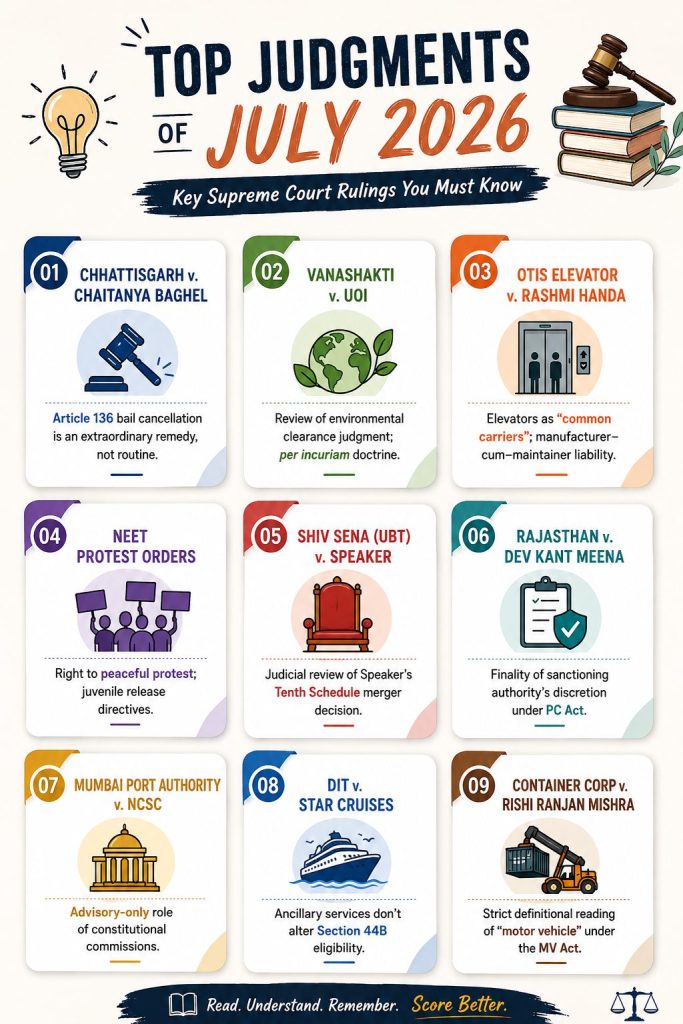
Criminal Law & Bail Jurisprudence: State of Chhattisgarh v. Chaitanya Baghel (The Liquor Scam Bail Case)
Bench: CJI Surya Kant, Joymalya Bagchi & V. Mohana, JJ.
Facts
- Chaitanya Baghel was an accused in the alleged Rs. 2,833 crore Chhattisgarh liquor scam, a large-scale case involving allegations of a coordinated excise policy fraud.
- He had already been granted bail by the trial court.
- Dissatisfied with this, the State of Chhattisgarh approached the Supreme Court under Article 136 of the Constitution, seeking cancellation of that bail.
Issues
- Whether the Supreme Court should exercise its discretionary jurisdiction under Article 136 to cancel a bail order that had already been granted?
- What standard should govern such interference with liberty already granted?
- Does the routine practice of states challenging bail orders at the apex court, rather than treating that route as exceptional, deserve judicial disapproval?
Constitutional Principle Involved
This case turns on Article 136 of the Constitution, which gives the Supreme Court a discretionary power to grant special leave to appeal against any judgment, decree, or order of any court or tribunal in India.
Article 136 has never been treated as a regular avenue of appeal; the Court has consistently held it to be an extraordinary, residuary power meant for exceptional situations, not a routine substitute for statutory appellate remedies.
The related principle at stake is the standard for cancelling bail once granted, which Indian courts have long distinguished from the standard for granting bail in the first place as cancellation requires stronger, supervening reasons, not a mere difference of opinion.
Judgment
- The Supreme Court refused to cancel Baghel’s bail.
- It held that interference with a bail order under Article 136 is warranted only where the continued liberty of the accused is “so egregious that it undermines the administration of justice” – a deliberately high threshold.
- The Court expunged certain adverse remarks that had been made against the investigating agency but left all other questions of law open for the trial court to decide on merits.
- The bench criticised the growing tendency of prosecuting agencies to treat the Supreme Court as a default forum for challenging every bail order, observing that when a prosecutor invests all their energy in fighting interlocutory liberty battles, it dilutes their real responsibility of securing a conviction at trial.
Environmental Law: Vanashakti v. Union of India (The Post-Facto Clearance Reversal)
Bench: CJI Surya Kant & Joymalya Bagchi, JJ. (Majority); Ujjal Bhuyan, J. (Dissenting)
Facts
- In May 2025, an earlier bench of the Supreme Court had struck down a 2017 government notification and a related 2021 Office Memorandum that allowed industries to obtain environmental clearance after they had already begun construction commonly referred to as “post-facto” environmental clearance.
- That 2025 judgment had called the very concept of retrospective clearance “completely alien to environmental jurisprudence” and effectively shut the door on it.
- The Union Government filed a review petition against that 2025 ruling, arguing that if it remained in force, projects worth an estimated Rs. 20,000 crore including public infrastructure like hospitals and airports would face demolition, since many of them had proceeded on the strength of the very notification the Court had struck down.
Issues
- Whether a valid ground for review exists at all, given that review jurisdiction is narrower than appellate jurisdiction and cannot be used simply because a later bench disagrees with an earlier one?
- Whether the earlier judgment overlooked binding precedent, making it “per incuriam”?
Legal and Constitutional Principle Involved
This case is fundamentally about the scope of review jurisdiction under Article 137 of the Constitution, read with Order XLVII of the Supreme Court Rules. A judgment can be reviewed only on narrow grounds like discovery of new evidence, an error apparent on the face of the record, or being per incuriam of binding precedent not merely because the government finds the outcome inconvenient.
The case also engages core principles of environmental jurisprudence, particularly the “polluter pays” and precautionary principles that ordinarily disfavour retrospective legitimisation of environmental non-compliance, as well as the doctrine of promissory estoppel, since the Union had earlier assured the Madras High Court that the 2017 scheme was a one-time measure.
Judgment
Majority (CJI Surya Kant and Justice Bagchi):
- Recalled the May 2025 judgment.
- Held that the original ruling was per incuriam of coordinate-bench decisions that had earlier upheld the 2017 notification.
- Held that the Jan Vishwas Act, 2023 which decriminalises a range of regulatory violations supported the idea that the government could offer a conditional amnesty scheme for past environmental non-compliance rather than treating every violation as irreversible.
Dissent (Justice Ujjal Bhuyan):
- Held that no valid ground for review had been made out.
- Pointed out that the Union’s own assurance to the Madras High Court that the scheme was a one-time measure was being dishonoured.
- Warned that recalling the judgment “demotes the law to a mere suggestion.”
His dissent remains an important read for understanding the tension between judicial finality and administrative convenience precisely the kind of reasoning-based contrast CLAT PG likes to test.
Consumer Protection & Tort Law: OTIS Elevator Co. (India) Ltd. v. Rashmi Handa & Ors. (The Common Carrier Case)
Bench: Pamidighantam Sri Narasimha & Atul S. Chandurkar, JJ.
Facts
- A Research and Analysis Wing (RAW) officer died after being crushed in a malfunctioning elevator at the agency’s own headquarters.
- OTIS Elevator Co. was not just the manufacturer of the lift, it also held the maintenance contract for it, giving it dual responsibility over both the machine’s design and its upkeep.
- The victim’s family brought a consumer and tort claim seeking compensation, and the question of apportioning liability among OTIS, the maintenance agency, and RAW itself reached the Supreme Court.
Issues
- Which party bore primary liability for the accident- the manufacturer, the maintenance contractor (in this case, the same entity), or the premises occupier?
- Should the standard of care applicable to elevators be elevated to match that owed by transport providers who carry the public?
Legal and Constitutional Principle Involved
This case rests on the “common carrier” doctrine in tort and consumer law, traditionally applied to entities like railways, buses, and cabs, which owe passengers an unusually high duty of care because passengers have no independent ability to verify the safety of the equipment or vehicle they’re using.
It also involves principles of product liability, particularly the idea that a party with unique knowledge of and control over a product’s safety mechanisms bears a correspondingly higher share of responsibility when that product fails.
Judgment
- The Supreme Court held that “an elevator must be construed and deemed to be a common carrier,” extending the doctrine beyond its traditional transport context.
- Because OTIS was simultaneously the manufacturer and the maintenance contractor, the Court reasoned it possessed unique knowledge of and control over the safety systems involved, and therefore bore primary responsibility for the failure.
- Liability was apportioned as follows: OTIS 70%, the maintenance agency MES 25%, and RAW itself 5%.
- This judgment is now a leading authority on product liability claims against manufacturers who also provide ongoing maintenance services.
Constitutional Law & Fundamental Rights: In re: Student Protests Against NEET-UG 2026 Paper Leak
Bench: CJI Surya Kant, Joymalya Bagchi & V. Mohana, JJ.
Facts
- Following the leak of the NEET-UG 2026 examination paper, students across several states organised protests.
- In responding to these protests, police in multiple states used lathi charges, pellet guns, and tear gas.
- Several minors were arrested during the crackdown.
- The matter reached the Supreme Court through petitions seeking protection for the protesting students and accountability for the police response.
Issues
- Did the police response to a peaceful protest amount to an excessive and disproportionate use of force?
- Are the minors arrested during the protests entitled to immediate release?
- What interim protections were necessary to prevent coercive action against students who had no prior criminal record?
Legal and Constitutional Principle Involved
This matter engages Article 19(1)(b) of the Constitution, which guarantees the right to assemble peaceably and without arms a right that, along with freedom of speech under Article 19(1)(a), forms the constitutional basis for the right to protest.
It also involves the Juvenile Justice (Care and Protection of Children) Act, 2015, particularly its provisions on the treatment and release of minors in conflict with the law, and the broader principle of proportionality in policing, which requires that the force used by the state in maintaining order be proportionate to the actual threat posed.
Judgment
- The Supreme Court ordered the immediate release of all minors who had been arrested during the protests.
- It restrained further coercive action against students without prior criminal antecedents.
- It directed that all CCTV, drone, and body-camera footage from the protests be preserved rather than allowed to lapse.
- The bench found a prima facie case of police excess serious enough to warrant an independent enquiry and issued notice to the Centre, Delhi, and seven states.
- CJI Surya Kant observed: the constitutional right to peaceful, lawful protest cannot be denied merely because a demonstration happens to be underway.
Constitutional Law & Anti-Defection: Shiv Sena (UBT) v. Lok Sabha Speaker (The MP Merger Challenge)
Bench: P.S. Narasimha & Alok Aradhe, JJ.
Facts
- Six Members of Parliament originally elected on the Uddhav Thackeray-led Shiv Sena (UBT) ticket were recognised by Lok Sabha Speaker Om Birla as having merged with the Eknath Shinde-led Shiv Sena faction.
- This is the latest development in a conflict that began with the original Shiv Sena split in 2022, which had earlier produced a significant Constitution Bench ruling on defection and symbol allocation in 2023.
- The UBT faction challenged the Speaker’s recognition of this merger before the Supreme Court.
Issues
- Is the Speaker’s decision to recognise a party merger under the Tenth Schedule subject to judicial review?
- If so, on what grounds can a court examine that decision – procedural fairness, the adequacy of the Speaker’s reasoning, or something narrower?
Legal and Constitutional Principle Involved
This case sits squarely within anti-defection law under the Tenth Schedule of the Constitution, specifically the provisions governing when a merger of a political party (and its members) is validly recognised, as opposed to constituting disqualifying defection.
It also raises the broader constitutional question of how far courts can go in reviewing decisions made by a Speaker acting in a quasi-judicial capacity, an area where the Supreme Court has previously drawn a careful line between legitimate judicial review and undue interference with parliamentary functioning.
Judgment
- At this stage, the Supreme Court has only issued notice in the matter; there is no final ruling yet.
- The bench has flagged the case as raising fundamental questions about the Speaker’s authority under the Tenth Schedule and the scope of judicial review over parliamentary decisions on party mergers.
- Since the matter remains pending, CLAT PG aspirants should track this one for further developments rather than treating it as settled law but the issue itself, judicial review of a Speaker’s Tenth Schedule decisions, is worth understanding well regardless of the eventual outcome.
Anti-Corruption Law: State of Rajasthan & Ors. v. Dev Kant Meena (The Sanction Finality Case)
Bench: Sanjay Karol & Augustine George Masih, JJ.
Facts
- The competent sanctioning authority in Rajasthan had earlier declined to grant sanction to prosecute a public servant (a doctor) under the Prevention of Corruption Act, 1988.
- The State Government subsequently sought to revisit that decision, essentially reviewing its own earlier refusal using the same set of materials that had already been considered the first time around.
Issues
- Can a decision refusing prosecution sanction under the Prevention of Corruption Act be reviewed or reversed by the same government on identical materials, without any new facts or evidence coming to light?
Legal Principle Involved
This case involves Section 197 of the Code of Criminal Procedure (and the equivalent sanction provisions under the Prevention of Corruption Act), which require prior sanction from the government before a public servant can be prosecuted for acts done in the discharge of official duty.
The safeguard exists to protect honest public servants from vexatious or politically motivated prosecutions.
Judgment
- The Supreme Court held that once a sanctioning authority exercises its discretion to refuse prosecution sanction, that decision is final and cannot be reviewed on the same materials by the State Government.
- The bench imposed costs of Rs. 1 lakh on the State of Rajasthan, finding that the attempt to prosecute the doctor was politically motivated rather than grounded in genuine new evidence.
Administrative Law: Mumbai Port Authority v. National Commission for Scheduled Castes (The Advisory Powers Case)
Bench: Sanjay Karol & Augustine George Masih, JJ.
Facts
- The National Commission for Scheduled Castes had passed an order in a service-related dispute involving the Mumbai Port Authority, purporting to bind the authority on a matter concerning an employee’s service conditions.
- The Mumbai Port Authority challenged the Commission’s power to issue such a binding order.
Issues
- Does the National Commission for Scheduled Castes, a body constituted under Article 338 of the Constitution, have the power to pass orders in service disputes that are binding and enforceable in the same manner as a judicial order?
Constitutional Principle Involved
Article 338 of the Constitution establishes the National Commission for Scheduled Castes and defines its functions, which are primarily investigative and recommendatory to monitor safeguards for Scheduled Castes, investigate specific complaints, and advise the government on matters relating to their welfare.
This case tests the important distinction in administrative law between a “recommendatory” body, whose views are persuasive but not binding, and an “adjudicatory” body, whose orders carry the force of a judicial decision.
Judgment
- The Supreme Court held that the National Commission for Scheduled Castes cannot pass binding orders in service disputes, since its constitutional role under Article 338 is advisory in nature.
- The Commission’s recommendations are not enforceable as judicial orders and must yield to the statutory framework that actually governs service matters, such as the relevant service rules and the jurisdiction of courts and tribunals empowered to adjudicate such disputes.
Taxation Law: Director of Income Tax (International Taxation) v. M/s. Star Cruises (India) Pvt. Ltd. (The Presumptive Taxation Ruling)
Bench: S.V.N. Bhatti & N.V. Anjaria, JJ.
Facts
- Star Cruises operated cruise ships offering passenger travel along with onboard hospitality and entertainment services.
- The company had been assessed for tax under Section 44B of the Income Tax Act, 1961, which provides a presumptive taxation scheme for the business of operating ships.
- The Assessing Officer contended that because the cruises offered substantial onboard hospitality and entertainment, the business could no longer be characterised purely as “carriage” of passengers, and therefore should not qualify for the presumptive scheme.
Issues
- Does providing onboard hospitality and entertainment services alongside passenger transport change the fundamental character of a cruise operator’s business, such that it falls outside the scope of Section 44B ?
Legal Principle Involved
This case turns on the interpretation of Section 44B of the Income Tax Act, 1961, which offers a simplified, presumptive method of computing taxable income for non-resident entities engaged in the business of operating ships, based on a fixed percentage of gross receipts rather than requiring detailed accounting.
The core interpretive principle at stake is distinguishing a business’s “primary” activity from services that are merely “ancillary” to it, a distinction that recurs across tax law and beyond, wherever a statute defines eligibility by reference to the essential nature of a business.
Judgment
- The Supreme Court held that cruise operators remain eligible for presumptive taxation under Section 44B.
- It ruled that onboard hospitality and entertainment services are merely ancillary to the primary business of passenger carriage.
- It rejected the Revenue’s restrictive interpretation of “carriage” as requiring strict port-to-port transportation with nothing else attached.
- It affirmed the concurrent findings of the CIT(A), the ITAT, and the Bombay High Court, and dismissed the Revenue’s appeals.
Motor Vehicles Law: Container Corporation of India Ltd. v. Rishi Ranjan Mishra (The Reach Stacker Case)
Decided: July 29, 2026
Facts
- An accident occurred inside an enclosed, customs-bonded inland container depot involving a “Reach Stacker” – heavy machinery used to lift and move shipping containers within the depot.
- The injured party sought compensation before the Motor Accident Claims Tribunal (MACT), treating the Reach Stacker as a “motor vehicle” for the purposes of claiming compensation under the Motor Vehicles Act, 1988.
Issues
- Does a Reach Stacker, used exclusively within an enclosed depot and not on any public road, qualify as a “motor vehicle” under the Motor Vehicles Act, 1988?
- Could a victim injured by it seek compensation through the Motor Accident Claims Tribunal?
Legal Principle Involved
This case involves the statutory definition of “motor vehicle” under Section 2(28) of the Motor Vehicles Act, 1988, and the settled principle that where a statute provides a specific definition for a term, courts must apply that definition strictly rather than substituting a broader, common-sense understanding of the word.
The Motor Vehicles Act’s compensation framework has historically been tied to vehicles used on public roads or public places, which is central to how “motor vehicle” and “accident” are understood under the Act.
Judgment
- The Supreme Court held that a Reach Stacker used in an enclosed, customs-bonded inland container depot is not a “motor vehicle” under the Motor Vehicles Act, 1988, because the statutory definition requires use on public roads or public places.
- As a result, the accident victim could not approach the Motor Accident Claims Tribunal for compensation.
- The victim would need to pursue other available remedies instead, such as a claim under industrial or employee compensation law.
How to Revise These Cases
Don’t try to memorise the facts first, memorise the ratio, and let the facts serve as the hook that helps you recall it. Group each case under the provision or doctrine it really belongs to, so the Baghel case sits in your notes under “Article 136,” the OTIS case under “tort and consumer law,” and the Vanashakti case under “review jurisdiction.”
Where a bench is split, as it was in Vanashakti, read both the majority and the dissent properly that is exactly where CLAT PG tends to build its more demanding reasoning questions, since a simple “what did the Court decide” won’t help you there.
Get case-law updates weekly
Join 10,000+ subscribers.
SH
Shruti chauhan
Contributing author
Have a doubt about this judgment?Ask Doubts