
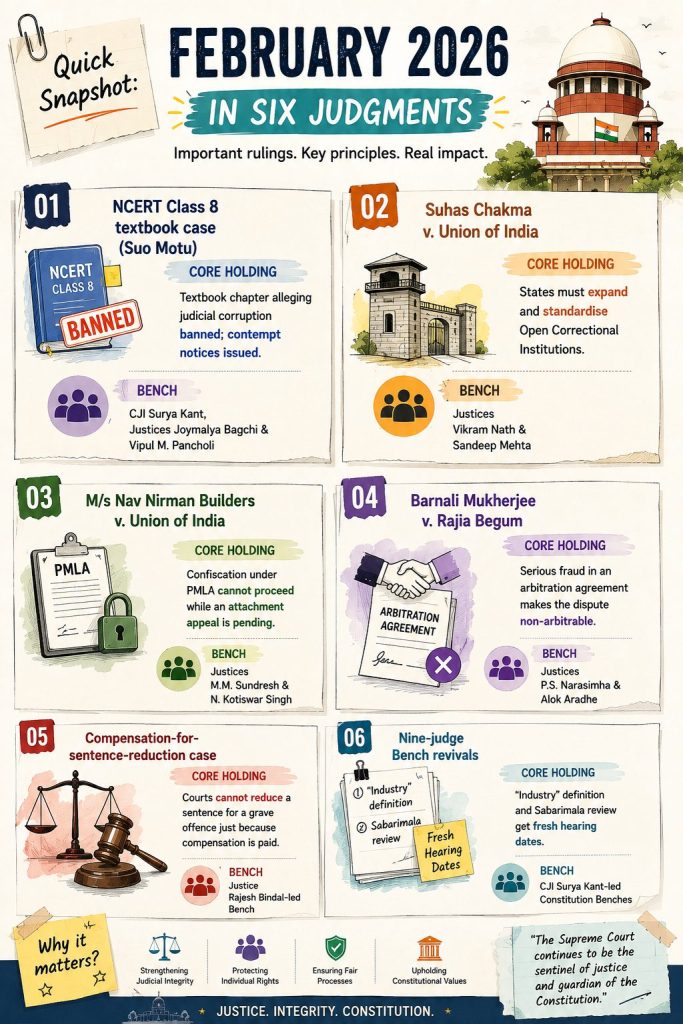
February 2026 kept the Supreme Court busy on institutional integrity as much as individual rights. The Court banned a school textbook for questioning judicial credibility, ordered states to open their prisons to independent oversight, and drew sharper lines around money-laundering confiscation and arbitration fraud. Two dormant Constitution Bench references also came back to life this month.
This Article walks you through every major ruling in plain, exam-ready language. You will finish with a clear picture of where the law stood in February 2026 and why each decision matters.
1. Supreme Court Bans NCERT Textbook Over “Corruption in Judiciary” Chapter
Date: February 26, 2026
Bench: Chief Justice Surya Kant, Justices Joymalya Bagchi and Vipul M. Pancholi
What happened
News reports on February 24, 2026, revealed that a new NCERT Class 8 Social Science textbook, Exploring Society: India and Beyond, contained a chapter titled “The Role of the Judiciary in our Society” with a sub-topic on corruption in the judiciary. Senior advocates raised the issue directly before the Chief Justice’s bench, calling it an attempt to scandalise the institution. The Court took suo motu notice and acted within forty-eight hours.
What the Court held
The Court did not treat this as a minor curriculum error. It held that:
- The chapter, when read alongside the judiciary’s institutional history and public role, omitted the substantive contributions of the Supreme Court, High Courts, and district courts while highlighting only allegations of corruption. The Court called this a “deep-rooted conspiracy” to erode public trust.
- It ordered an immediate, nationwide ban on the book’s printing, publication, and digital circulation, and directed the Centre and state governments to seize physical copies and remove digital versions without delay.
- It issued show-cause notices to the Secretary of the Department of School Education and Literacy and to the NCERT Director, asking why the Court should not initiate contempt proceedings against them.
- The Court noted that when the NCERT Director was first asked to verify the book’s contents, he defended them instead of showing any introspection, a response the Court found troubling.
- The Court clarified that it did not intend to suppress legitimate criticism of the judiciary. Its concern was the pedagogical propriety of introducing such material to Class 8 students without context or balance.
- NCERT subsequently withdrew the book, called the error “unintentional,” and promised to rewrite the chapter in consultation with appropriate authorities before the 2026-27 academic session.
Why this matters
This is a rare instance of the Supreme Court using its contempt jurisdiction against an educational publisher rather than a media outlet or individual. It signals that institutions publishing content about the judiciary, even in a school curriculum, carry a real risk of contempt liability if that content is one-sided or unverified.
2. Prison Reforms: Supreme Court Pushes Open Correctional Institutions
Case: Suhas Chakma v. Union of India
Bench: Justices Vikram Nath and Sandeep Mehta
What happened
A writ petition under Article 32 raised concerns about severe prison overcrowding across India and the inhuman detention conditions that follow from it. The petitioner argued that this overcrowding violates prisoners’ fundamental rights under Article 21.
What the Court held
Rather than issuing another generic directive on overcrowding, the Court focused on a specific, workable solution:
- Open Correctional Institutions (OCIs), which allow prisoners with good conduct records to live with greater freedom and responsibility, embody the constitutional promise of reform over pure punishment.
- The Court held that trust, responsibility, and graded liberty form essential parts of meaningful prison reform, not just humane treatment.
- It directed states and union territories to expand OCIs and apply uniform governance standards across them, so that access to this system does not depend on which state a prisoner happens to be in.
- The ruling builds on a broader push by the Court, seen elsewhere in February 2026, for states to constitute independent Boards of Visitors to monitor prison conditions and bring transparency to prison administration.
Why this matters
India’s prisons operate at well over their sanctioned capacity in many states. This judgment gives prison reform advocates a concrete, replicable model rather than another set of abstract principles, and it puts a specific administrative burden on states to standardise how they run open prisons.
3. PMLA Confiscation Cannot Proceed While an Attachment Appeal Is Pending
Case: M/s Nav Nirman Builders & Developers Pvt. Ltd. v. Union of India
What happened
The Enforcement Directorate had attached the appellant company’s property under Section 8(3) of the Prevention of Money Laundering Act, 2002. The company appealed this attachment order to the Appellate Tribunal under Section 26 of the PMLA. While that appeal remained pending, the Special Court went ahead and ordered confiscation of the same property under Section 8(7).
What the Court held
A bench of Justices M.M. Sundresh and N. Kotiswar Singh set aside the confiscation order and laid down a clear procedural rule:
- Once a person challenges an attachment order under Section 8(3) before the Appellate Tribunal, the High Court, or the Supreme Court, a deemed embargo applies. The Special Court cannot conclude confiscation proceedings under Section 8(7) until that higher forum decides the appeal.
- The order passed by the higher forum, once it comes, supersedes and replaces the original Section 8(3) order.
- The Court directed the Appellate Tribunal to decide the pending appeal within four weeks and told the Special Court to keep the confiscation application pending until then.
Why this matters
This ruling stops enforcement agencies from finalising confiscation while a person’s appeal against attachment is still alive. It reinforces a basic principle of due process: authorities cannot treat a challenged order as final while the challenge itself remains undecided.
4. When Fraud Makes an Arbitration Agreement Non-Arbitrable
Case: Barnali Mukherjee v. Rajia Begum
Bench: Justices Pamidighantam Sri Narasimha and Alok Aradhe
What happened
A dispute arose over whether an arbitration agreement itself was genuine, with allegations that it had been forged or fabricated. The question before the Court was whether a serious fraud allegation of this kind should go to a civil court or to an arbitral tribunal.
What the Court held
The Court reinforced and clarified a two-test framework for such disputes:
- Courts must first ask whether the fraud allegation permeates the entire contract, including the arbitration clause itself, in a way that could undo the very foundation of the agreement.
- Courts must then ask whether the allegations are too complex for an arbitral tribunal to fairly examine, requiring a full civil trial instead.
- The Court drew a firm line between simple fraud, which involves disputes over how a contract was performed and remains arbitrable, and serious fraud, such as forgery at the point the agreement was created, which is non-arbitrable.
- It also held that prima facie findings made during interim proceedings, such as those under Section 9 of the Arbitration and Conciliation Act, 1996, can carry significant weight if those findings later attain finality.
Why this matters
This ruling protects parties from being forced into arbitration when the arbitration agreement itself is the product of fraud. It gives litigants and lawyers a workable test to decide, early in a dispute, whether a case belongs in arbitration or in court.
5. Courts Cannot Reduce Sentences in Grave Offences Just Because Compensation Is Paid
What happened
In an appeal arising from a Madras High Court judgment, a trial court had convicted the accused under Sections 307, 326, and 324 of the Indian Penal Code, 1860, and imposed three years of rigorous imprisonment. The High Court upheld the conviction but reduced the sentence to time already served, in exchange for enhanced compensation paid to the victim’s spouse.
What the Court held
A Division Bench led by Justice Rajesh Bindal firmly deprecated this practice. The Court held that:
- Reducing a sentence for a grave offence, such as attempt to murder, merely because the accused pays enhanced compensation, sends the wrong message about the seriousness of violent crime.
- Compensation to a victim serves a separate purpose from punishment and cannot substitute for an appropriate sentence in offences that cause serious bodily harm.
- Courts must resist converting criminal sentencing into a transaction where wealthier accused persons can effectively buy down their punishment.
Why this matters
This ruling matters for criminal law practitioners and trial courts alike. It reins in a growing trend of High Courts softening sentences in serious injury cases through compensation-linked settlements, and it reaffirms that grave offences demand punishment proportionate to the harm caused, not just financial restitution.
6. Two Long-Dormant Constitution Bench References Come Back to Life
Date: February 16 and 19, 2026
What happened
The Supreme Court revived two significant nine-judge and Constitution Bench matters that had been pending for years:
- The definition of “industry” under Section 2(j) of the Industrial Disputes Act, 1947, last authoritatively settled in Bangalore Water Supply v. R. Rajappa (1978). The Court scheduled arguments to begin March 17, 2026, running over two days.
- The Sabarimala temple entry review, with parties supporting the review scheduled to argue between April 7 and 9, 2026, and opposing parties between April 14 and 16, 2026.
Separately, on February 19, 2026, the Court also began hearing a batch of petitions challenging the constitutionality of the Citizenship Amendment Act (CAA) after a gap of nearly two years, directing that pan-India concerns be argued first, followed by matters specific to Assam and Tripura.
Why this matters
These are three of the most closely watched constitutional matters in India. Their revival after years of inactivity signals that the Court intends to resolve foundational questions on labour law classification, religious freedom, and citizenship that have remained unsettled for a long time. Aspirants should track the hearing schedules closely, since final rulings could reshape entire areas of law.
Other Notable Developments in February 2026
- The Court reaffirmed that a customs officer is not a “police officer” for the purposes of Sections 24, 25, and 30 of the Evidence Act, 1872, meaning a voluntary confession recorded under Section 108 of the Customs Act remains admissible as substantive evidence.
- The Court directed the Delhi High Court to hear, out of turn, the criminal appeal filed by former MLA Kuldeep Singh Sengar in the custodial death case connected to the Unnao incident.
- In Mostari Banu v. Election Commission of India (2026 SCC OnLine SC 304), the Court permitted the Chief Justice of the Calcutta High Court to requisition judges from Jharkhand and Odisha, and allowed experienced Civil Judges in West Bengal to assist with the Special Intensive Revision of electoral rolls.
- The Court set aside an Allahabad High Court decision in a POCSO matter, continuing its close scrutiny of how High Courts handle child sexual offence cases.
- The Court granted bail in a Narcotic Drugs and Psychotropic Substances Act case after the accused spent over three years in undertrial custody with 159 witnesses still to be examined, cautioning against prosecutions that multiply witnesses unnecessarily on the same issue.
- The Court raised concerns about lawyers using AI tools to draft petitions containing non-existent judgments and inaccurate citations, an issue that would grow into a full misconduct ruling later in the year.
Want structured, exam-focused updates on every major judgment as it drops? Explore our CLAT PG prep courses for detailed case briefs, Notes, MCQs, and mentor-led discussions on current legal developments.
Get case-law updates weekly
Join 10,000+ subscribers.
SH
Shruti chauhan
Contributing author
Have a doubt about this judgment?Ask Doubts