
Environmental law forms one of the most scoring yet under-prepared areas for CLAT PG aspirants. This series breaks down the foundational judgments that every serious candidate must know cold. Part 1 covers the cases that built the bedrock principles of Indian environmental jurisprudence.
Foundational Principles
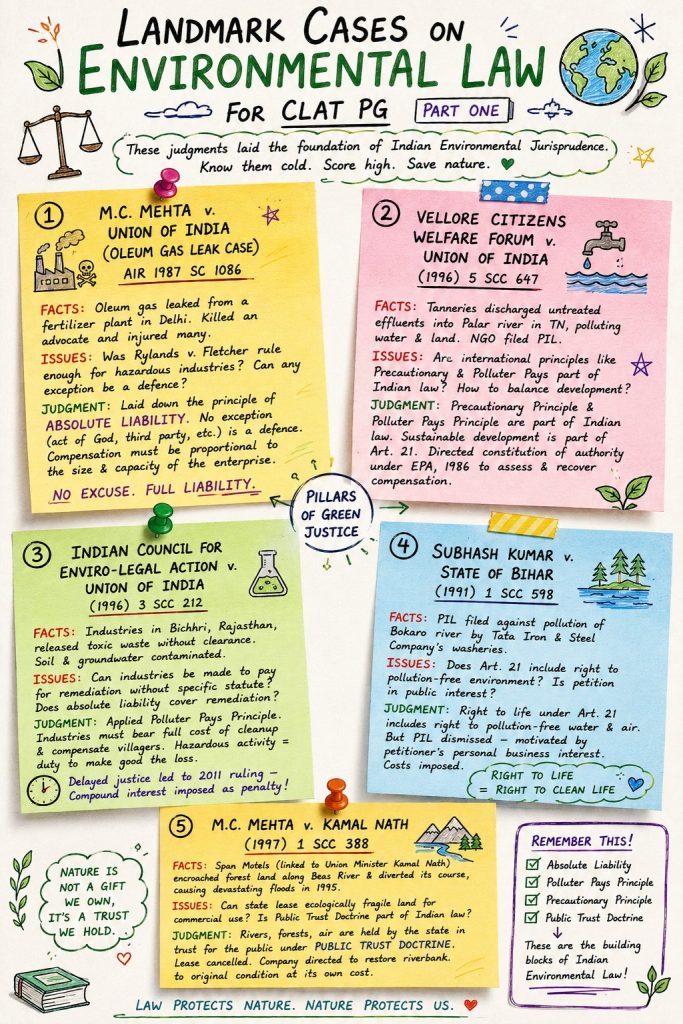
M.C. Mehta v. Union of India (Oleum Gas Leak Case) AIR 1987 SC 1086
Facts: In December 1985, oleum gas leaked from the Shriram Food and Fertilizers plant in the densely populated Kirti Nagar area of Delhi. The leak killed an advocate and caused injury to several residents nearby. A second leak followed within days. M.C. Mehta filed a writ petition seeking closure of the hazardous unit and compensation for the affected persons.
Issues:
- The Court had to decide whether the old rule of strict liability from Rylands v. Fletcher was adequate for modern hazardous industries.
- It also examined whether an enterprise engaged in inherently dangerous activity could escape liability by pleading any exception at all.
Judgment: Chief Justice Bhagwati rejected the century-old Rylands rule as insufficient for a country with rapidly industrialising hazardous sectors. The Court laid down the principle of absolute liability, holding that an enterprise engaged in hazardous activity owes an unconditional duty to the community.
No exception, whether an act of God or third-party sabotage, could be pleaded as a defence. Moreover, the Court held that compensation must be proportional to the size and capacity of the enterprise, so that the deterrent effect actually bites.
Vellore Citizens Welfare Forum v. Union of India (1996) 5 SCC 647
Facts: Hundreds of tanneries and other industries in Tamil Nadu were discharging untreated effluents into the Palar river, the primary source of drinking water for local residents. An NGO filed a PIL under Article 32 challenging this unchecked pollution of agricultural land and waterways.
Issues:
- The central question was whether international environmental principles such as the Precautionary Principle and the Polluter Pays Principle formed part of Indian environmental law, even though they were not codified in domestic statutes.
- The Court also examined how sustainable development ought to be balanced against industrial growth.
Judgment: The Supreme Court held that the Precautionary Principle and Polluter Pays Principle are essential features of sustainable development and, therefore, part of India’s environmental law. It further held that sustainable development itself is embedded within the right to life under Article 21.
However, the Court did not stop at declarations; it directed the constitution of an authority under the Environment Protection Act, 1986 to assess and recover compensation from polluting industries.
Indian Council for Enviro-Legal Action v. Union of India (1996) 3 SCC 212
Facts: Chemical industries in Bichhri village, Udaipur district of Rajasthan, manufactured ‘H’ acid and other toxic chemicals without obtaining the required environmental clearances. The untreated effluent and sludge contaminated soil and groundwater across the region, devastating the livelihoods of local villagers.
Issues:
- The Court had to determine whether the polluting industries could be held liable for the cost of remediation even in the absence of a specific statutory provision fixing such liability.
- It also considered whether the earlier absolute liability standard from the Oleum Gas Leak case extended to environmental remediation costs.
Judgment: The Supreme Court firmly applied the Polluter Pays Principle, holding that the offending industries were liable to bear the entire cost of remedial measures and compensation to the affected villagers.
The Court reasoned that once an activity is hazardous, the enterprise carrying it out is duty-bound to make good the loss regardless of fault. Notably, the industries dragged the enforcement of this judgment for over fifteen years, which eventually led to a follow-up ruling in 2011 imposing compound interest at 12% as a penalty for the delay.
Article 21 and Right to Environment
Subhash Kumar v. State of Bihar (1991) 1 SCC 598
Facts: Subhash Kumar filed a PIL alleging that sludge and slurry discharged from the washeries of Tata Iron and Steel Company were polluting the Bokaro river. He sought directions against the State of Bihar and the pollution control authorities to prevent further contamination.
Issues:
- The Court examined whether the right to a pollution-free environment could be read into the right to life under Article 21.
- It also had to decide whether the petition, filed by a person with a commercial interest in slurry collection, genuinely served the public interest.
Judgment: The Supreme Court held that the right to life under Article 21 includes the right to enjoyment of pollution-free water and air. This was a significant expansion of Article 21 into environmental protection. However, the Court dismissed the actual petition, finding that it was motivated by the petitioner’s personal business interest rather than genuine public concern, and imposed costs on him.
M.C. Mehta v. Kamal Nath (1997) 1 SCC 388
Facts: Span Motels Private Limited, a company closely linked to the family of then Union Minister Kamal Nath, encroached upon forest land along the River Beas in Himachal Pradesh. The company diverted the river’s course to protect its resort from flooding, which led to a major flood in September 1995 causing extensive damage.
Issues:
- The primary issue was whether the state government could lease ecologically fragile riverbank land to a private party for commercial purposes.
- The Court also had to determine whether the Public Trust Doctrine, a concept borrowed from Roman and English law, formed part of Indian law.
Judgment: The Supreme Court held that natural resources such as rivers, forests, and air are held by the state in trust for the public and cannot be transferred to private parties for commercial exploitation.
The lease granted to Span Motels was cancelled, and the company was directed to restore the riverbank to its original condition at its own cost. This judgment firmly embedded the Public Trust Doctrine into Indian environmental jurisprudence for the first time.
Get case-law updates weekly
Join 10,000+ subscribers.
HA
Hanspal Bakul
Contributing author
Have a doubt about this judgment?Ask Doubts