
The right to freedom under article 19 to 22 of the Indian Constitution is the foundation of personal liberty. Personal liberty stands out as the most important fundamental right among all.
The Supreme court has shaped these articles through landmark judgments by defining freedom of speech, expanding personal liberty, and setting strict procedural safeguards against arrest and detention. This article provides for the landmark rulings of articles 19 to 22.
Article 19 – Protection of certain rights regarding freedom of speech, etc.
Article 19 (1) provides 6 fundamental freedoms to Indian citizens – freedoms of speech, assembly, association, movement, residence and profession. However, these rights are not absolute, they are subject to reasonable restrictions.
Freedom of speech and Press
Romesh Thappar v. state of Madras (1950)
Facts – The Madras government banned the entry and circulation of romesh thappar’s weekly journal, ‘cross roads’ under madras maintenance of public order act.
Issue – Does the freedom of speech under article 19(1)(a) include the freedom to circulate a publication?
Held – The supreme court observed that article 19(1)(a) includes the freedom of circulation. The supreme court held that madras maintenance of public order unconstitutional. The court stated that ‘public order’ was not an explicit ground for restriction under article 19(2) at that time.
Brij Bhushan v. State of Delhi (1950)
Facts – The chief commissioner of Delhi issued an order requiring the printer and publisher of weekly journal ‘organizer’ to submit all the manuscripts before publishing for approval from the government.
Issue – Does imposing prior censorship on publication violates freedom of speech and press?
Held – Supreme court held the pre-censorship violates freedom of speech and expression. The court ruled that it is a restriction on press liberty and on the fundamental right to free expression.
Bennett Coleman & Co. v. UOI(1972)
Facts – The government introduced the ‘newsprint control order’ policy. This policy restricted large newspapers and fixed the number of pages they could published.
Issue – Can the government use orders to restrict the physical size and circulation of newspapers?
Held – Supreme court struck down such policy as unconstitutional and held that the government cannot control the circulation by restricting it. It was held that this policy violates article 19(1)(a).
Bijoe Emmanuel v. State of Kerala (1986)
Facts – The school expelled three children for refusing to sing national anthem, though they stood up respectfully whenever it was played.
Issue – Does forcing students to sing the national anthem against their religious beliefs violate article 19(1)(a) and 25?
Held – The supreme Court reversed the expulsion, ruling that the right to freedom of speech and expression includes the right to remain silent. It held that respectful silence does not disrespect the national anthem.
Free Speech in Digital Age
Shreya Singhal v. UOI (2015)
Facts – Police arrested two young women under section 66A of IT Act for posting and liking facebook comments criticizing the total shutdown of Mumbai after a politician’s death.
Issue – Does section 66A of IT Act violate the right to free speech under article 19(1)(a)?
Held – Supreme court struck down section 66A of the IT Act declaring it as unconstitutional. It ruled that section created a ‘chilling effect’ on free speech and did not fall under any reasonable restrictions listed under article 19(2).
Anuradha Bhasin v. UOI (2020)
Facts – The government imposed an absolute shutdown of the internet in Jammu & Kashmir following the removal of article 370.
Issue – Does an indefinite suspension of internet services by the state government violate the fundamental right to freedom of speech, expression and trade?
Held – Supreme Court ruled that online free speech is a fundamental constitutional right under article 19(1)(a). Indefinite internet bans are illegal. The government must publish all shutdown orders for judicial review.
Right to vote
UOI v. Association for Democratic reforms (2002)
Facts – A public interest lawsuit requested that the law force candidates contesting elections to disclose their personal backgrounds, so that voters can make an educated choice.
Issue – does a citizen’s fundamental right to freedom of expression under article 19(1)(a) include the right to know the assets, liabilities, education and criminal records of election candidates?
Held – Supreme court held that voters’ right to know about candidates is the fundamental right and helps in expressing the right to vote.
Article 20 – Protection in respect of conviction for offences
It provides vital constitutional protections to the accused.
Kedar Nath v. State of West Bengal (1953)
Facts – The accused committed a financial offense in 1947, and the court convicted him 1949. By the time court convicted him, the legislature had amended the law to add a heavy monetary fine in addition to imprisonment.
Issue – Can state retroactively apply an enhanced penalty to an offense committed before the amendment became law?
Held – Supreme Court struck down the retroactive fine under article 20(1). It held that a person cannot be subjected to a penalty greater than what the law prescribed at the time the offense occurred.
Maqbool Hussain v. state of bombay (1953)
Facts – The customs department confiscated gold from the accused under the sea customs act. Later, the state criminally prosecuted him for the same act under the foreign exchange regulation act (FERA).
Issue – Is it a violation of double jeopardy under article 20(2) to face a criminal trial after already being punished from administration.
Held – The court held that the customs penalty did not amount to “prosecution and punishment” under Article 20(2). Thus, administrative confiscations do not count as judicial prosecution, so the trial was valid.
Selvi v. State of Karnataka (2010)
Facts – Investigating agencies used involuntary scientific methods like narco analysis, polygraph tests and brain mapping on suspects without their consent in order to get evidence.
Issue – Does forcing an accused person to undergo narco- analysis tests violates the right against self-incrimination and the right to remain silent?
Held – The court ruled that forcing someone to undergo these tests violates article 20(3) and right to mental privacy (article 21). The right to remain silent protects the mental privacy of an individual. Agencies cannot take information from person’s mind without their consent.
Article 21 – Protection of life and personal liberty
This article is the most progressive provisions of law. It provides that the state shall not deprive any person of his personal liberty and life except by the procedure established by law. To understand article 21 fully, one needs to analyze it in two distinct aspects i.e. prior to Maneka Gandhi case and transformation after the Maneka Gandhi case.
A.K. Gopalan v. State of Madras (Prior to Maneka Gandhi Case)
In this case a communist leader challenged his preventive detention under section 3(1) of the preventive detention act, 1950. The Supreme Court interpreted ‘ procedure established by law’ and held that it meant exactly what was wrote in the law. The court held that article 19 and article 21 are mutually exclusive and have to be read independently.
Maneka Gandhi v. UOI (1978)
The regional passport office impounded the passport of maneka gandhi on July 2, 1977, under section 10(3)(c) of the passport act, 1967. When she requested for her passport, she was denied by external affairs stating that it was for the interests of the general public.
The court in this case reversed the judgment of A.K. Gopalan case and held that articles 19 and 21 are interconnected. The court broadened the meaning of ‘personal liberty’ ruling that it includes all the foundational attributes and freedoms guaranteed under article 19.
Right to privacy
K.S. Puttaswamy v. UOI (2017)
Facts – Petitioners Challenged the validity of governments Aadhar biometric identification program, arguing that it violates the individual’s privacy by collecting data.
Issue – Is there any statutory fundamental right to privacy guaranteed under the constitution of India?
Held – The nine judge bench held that the right to privacy is a fundamental right. It ruled that privacy is an essential part of human dignity and personal liberty protected under article 21.
Right to Speedy Trial & Free legal aid
Hussainara Khatoon v. State of Bihar (1979)
Facts – A PIL exposed the worse condition of undertrial prisoners in the jails of Bihar. The state jailed thousands of poor men, women, and children for years awaiting trial. The prisoners could not afford lawyers or secure bail due to extreme poverty.
Issue – Do the rights to speedy trial and free legal aid constitute fundamental rights under article 21?
Held – The supreme court held that speedy trial is an essential part of ‘reasonable, fair, and just’ procedure under article 21. It is the mandatory duty of the state to provide free legal services to the poor and indigent accused persons.
Some other important cases of Article 21-
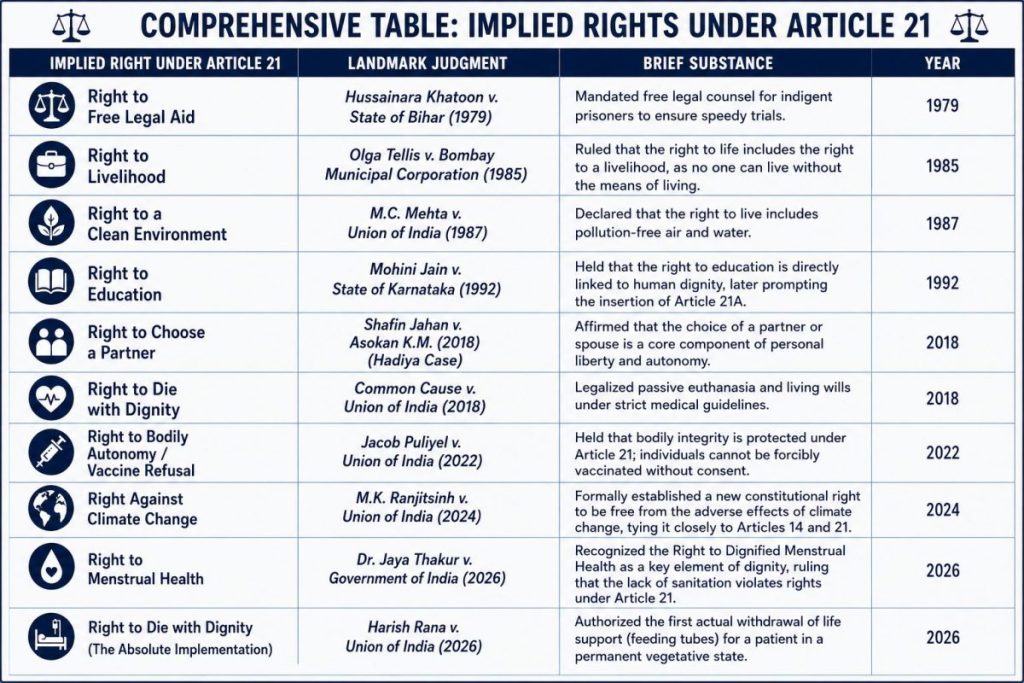
Article 22 – It provides protection against arbitrary arrest and detention.
Right to be informed of grounds of arrest
Joginder Kumar v. State of U.P. (1994)
Facts – The police summoned a 28 year old advocate for questioning. The police detailed him for 5 days without formal arrest or presentation before a magistrate. His relatives were not informed about his exact location. Petitioners filed a habeas corpus writ under article 32 in supreme court to secure his release.
Issues – whether police officers can arrest a citizen merely on an allegation of arrest and what are the necessary guidelines of arrest?
Held – A police officer can make an arrest merely because has the legal power to do so.
Supreme court mandated 3 guidelines –
- An arrested person has the right to have a friend or relative informed of their arrest and location as.
- Police officers must inform the arrested person of this right upon arrest.
- The police must make an entry in the police diary detailing whom they informed about the arrest.
Right to be defended by a lawyer of his own choice
Mohammed Ajmal Mohammad Amir Kasab alias Abu Mujahid v. State of Maharashtra (2012)
Facts – Ajmal Kasab, a Pakistani terrorist was involved in the 2008 Mumbai terror attack. On his arrest he denied the aid of Indian lawyers and demanded a lawyer specifically from his home country. But his home country gave no aid, so the court immediately assigned an Indian lawyer to him.
Issue – was the accused denied his constitutional right to be represented by the lawyer of his choice?
Held – The court held that it did not deny the accused his constitutional right to be represented by the lawyer of his choice, because it assigned an Indian lawyer as soon as the accused made the request.
Right against custodial torture
D.K. Basu. v. State of West Bengal (1997)
Facts – Executive Chairman of legal aid services, D.K. Basu wrote a letter to supreme court highlighting the large number of deaths, torture and brutality in the police custody. The supreme court treated the letter as a PIL.
Issue – Whether the lack of procedural safeguards during arrest and detention violates the constitutional right guaranteed under article 22?Whether custodial violence is a violation of article 21?
Held – it was held that custodial violence is a direct violation of article 21 right to life. Court also created mandatory guidelines of arrest which include –
- Police officer must wear a clear badge of his name and designation/
- A memo of arrest must be prepared at the time of arrest.
- The person arrested has a right to inform a friend or relative.
- The arrested person must undergo a medical examination every 48 hours, while they are in police custody.
Conclusion
In conclusion, the judiciary has expanded the scope of articles 19-22 by various landmark judgments. Cases like Maneka Gandhi and D.K.Basu proved that the government cannot take away a citizen’s freedom without a fair and honest process.
These rulings restricted police officers from abusing their power and protected the personal liberty of every person.
Get case-law updates weekly
Join 10,000+ subscribers.
JU
Julie Nigam
Contributing author
Have a doubt about this judgment?Ask Doubts