Precautionary Principle Under Environmental Law: Most Important for CLAT PG
Introduction
Imagine a company wants to build a factory near a lake that supplies drinking water to millions of people. Scientists cannot say with complete certainty how much damage the factory will cause. Should the government wait for proof of harm before acting, or should it act now to prevent harm that science has not yet fully confirmed?
The Precautionary Principle answers this question directly. It tells regulators and courts not to wait for scientific certainty when the environment faces a serious threat. It shifts the default response from "let's wait and see" to "let's act carefully now." This single shift has reshaped how India protects its rivers, forests, and cities.
This guide breaks down what the Precautionary Principle means, where it comes from, and how Indian courts apply it in real disputes.
What Does the Precautionary Principle Mean?
The Precautionary Principle states that when an activity threatens serious or irreversible harm to the environment, the absence of full scientific certainty should not stop authorities from taking protective measures. In plain terms, you do not need one hundred percent proof of danger before you can act to prevent it. If credible evidence points toward serious harm, the law lets you act first and debate the details later.
This idea flips the traditional approach to regulation. Older environmental laws usually required proof of actual damage before anyone could stop a harmful activity. The Precautionary Principle removes that requirement whenever the potential harm is serious and cannot be reversed once it happens.
Where the Precautionary Principle Comes From?
The principle did not begin in an Indian courtroom. It grew out of international environmental policy in the late twentieth century.
Germany introduced an early version of this idea in the 1970s through its domestic environmental policy, known as "Vorsorgeprinzip." The concept then spread across Europe and gained global attention through several international conferences.
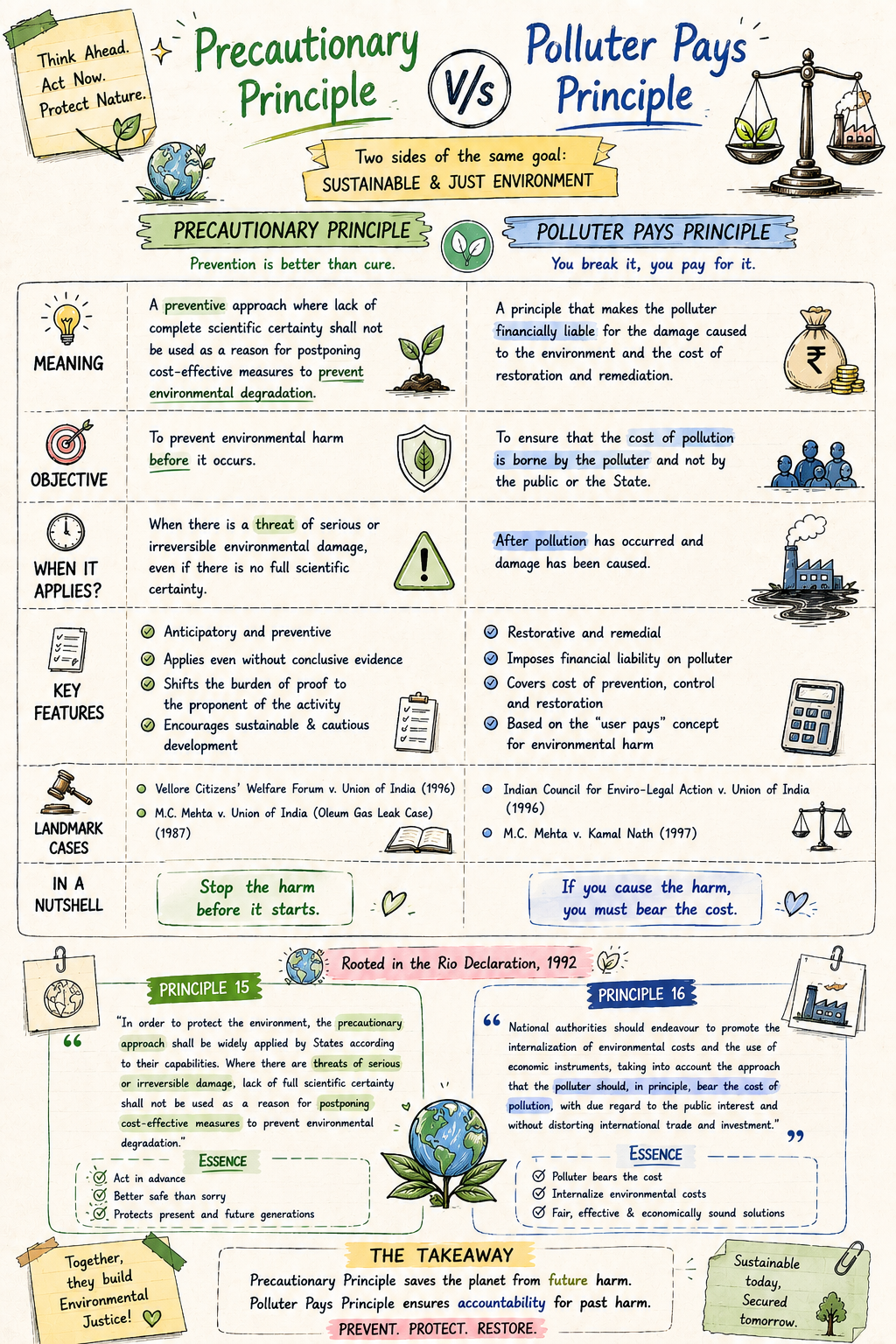
The Rio Declaration on Environment and Development, adopted in 1992 at the Earth Summit in Rio de Janeiro, gave the principle its most widely cited definition. Principle 15 of the Rio Declaration states that states shall apply the precautionary approach according to their capabilities, and that where threats of serious or irreversible damage exist, they shall not use a lack of full scientific certainty as a reason to postpone cost effective measures to prevent environmental degradation.
India drew directly from this language when its courts began applying the principle in the 1990s.
Legal Basis of the Precautionary Principle in India
India has built the Precautionary Principle on a strong constitutional and statutory foundation, even though no single law defines the term in isolation.
Constitutional Roots
The Supreme Court anchors the principle in Article 21 of the Constitution, which guarantees the right to life and personal liberty. Indian courts read this right to include the right to a clean and healthy environment. Once you accept that environmental protection forms part of the right to life, you can justify preventive action even before scientific certainty arrives, because waiting for proof could mean waiting until the damage becomes irreversible.
The Court has also drawn support from:
Article 47, which directs the State to raise public health standards.
Article 48-A, which requires the State to protect and improve the environment and safeguard forests and wildlife.
Article 51-A(g), which places a duty on every citizen to protect the natural environment.
Statutory Support
Environmental legislation gives regulators the tools to apply this principle in practice. The Environment (Protection) Act, 1986 grants the Central Government broad power to take preventive measures, including the power to restrict or prohibit activities that could harm the environment, even before actual damage occurs.
The National Green Tribunal Act, 2010 goes further and names the principle directly. Section 20 of the Act requires the Tribunal to apply the precautionary principle, along with the polluter pays principle and the principle of sustainable development, whenever it decides a case. This makes the Precautionary Principle a binding legal standard, not just a judicial preference.
Landmark Judgments That Shaped the Precautionary Principle in India
Indian courts have done most of the work in defining how this principle actually operates. A few judgments stand out.
Vellore Citizens' Welfare Forum v. Union of India (1996)
This case marks the first time the Supreme Court formally recognised the Precautionary Principle as part of Indian law. Tanneries in Tamil Nadu had discharged untreated effluents into the Palar river for years, poisoning groundwater and destroying agricultural land. The Court held that the principle forms part of the law of the land and applies wherever a serious and irreversible threat to the environment exists.
Justice Kuldip Singh, writing the judgment, identified three key elements of the principle. First, government authorities carry the responsibility to anticipate, prevent, and attack the causes of environmental harm rather than wait for damage to appear. Second, where serious or irreversible damage looms, courts should not treat scientific uncertainty as a reason to delay protective measures. Third, the party who wants to change the existing environmental status quo, not the party defending it, must prove that the change will cause no harm.
This third element became one of the most powerful tools in Indian environmental law, and later judgments developed it into a full doctrine on its own.
A.P. Pollution Control Board v. Prof. M.V. Nayudu (1999)
This case turned the third element from Vellore into a working legal rule. The dispute involved an industry that wanted to set up a vegetable oil extraction unit within ten kilometres of the Himayat Sagar and Osman Sagar reservoirs, which supplied drinking water to millions of people in Hyderabad and Secunderabad. The Andhra Pradesh Pollution Control Board refused permission, and the matter reached the Supreme Court.
The Court upheld the Board's refusal and explained that the Precautionary Principle naturally leads to a reversal of the burden of proof. Instead of asking the pollution control authority to prove that the project would cause harm, the Court placed the burden on the industry to prove that its project would cause no harm.
The Court reasoned that this approach protects the public, because expecting citizens or regulators to disprove safety in advance would place an unfair and often impossible burden on them.
This judgment gave regulators a practical way to apply precaution. When in doubt, authorities can require the party proposing a risky activity to demonstrate its safety before granting approval.
M.C. Mehta v. Union of India, the Taj Trapezium Case (1997)
The Supreme Court applied the Precautionary Principle to protect the Taj Mahal from industrial pollution in the surrounding Taj Trapezium Zone. The Court did not wait for conclusive proof linking every industry to the monument's decay. It ordered industries in the zone to switch to natural gas or relocate, placing the burden on industries to show that their operations would not harm the monument further. This case shows how the principle applies to cultural and historical heritage, not just to public health.
Precautionary Principle V/s Polluter Pays Principle
Conclusion
India continues to face pressure from rapid industrial growth, urban expansion, and climate change. New technologies, chemicals, and industrial processes often reach the market faster than science can fully study their long term effects.
The Precautionary Principle gives regulators a legal basis to act responsibly in the face of this uncertainty, rather than waiting for damage to become irreversible before stepping in.
The principle still faces challenges around consistent application and the balance between caution and development. Yet it remains one of the strongest legal tools available to protect India's environment for current and future generations.
Subscribe for updates
Join 10,000+ subscribers.
SH
Shruti chauhan
Contributing author
Have a doubt about this?Ask Doubts