
Ask any law student to define a contract, and here , comes the answer – offer, acceptance, consideration, free consent. But then throw in the term “quasi contract,” and most people freeze. Is it a contract? Is it not? Why does it even exist if there’s no agreement between the parties?
This confusion is exactly why quasi contracts show up so often in CLAT PG and other law entrance papers. It’s a small chapter, but it’s conceptually dense, and examiners love testing the difference between “contract,” “quasi contract,” and “tort” in a single question. This blog breaks the topic down the way it should be understood – not memorised.
What Exactly Is a Quasi Contract?
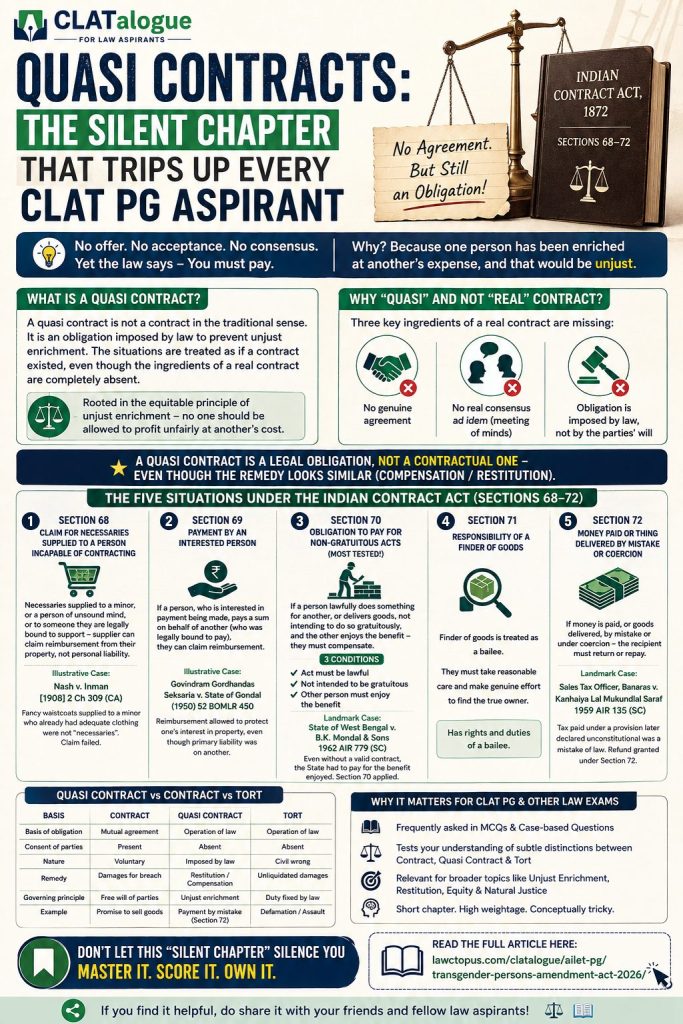
A quasi contract is not a contract at all in the traditional sense. There’s no offer, no acceptance, and often no meeting of minds between the parties. Yet the law treats certain situations as if a contract existed, because one party has received a benefit at another’s expense, and it would be unjust to let them keep it without paying for it.
This is rooted in the equitable principle of unjust enrichment – no one should be allowed to profit unfairly at someone else’s cost. English law calls these “quantum meruit” or “restitutionary” obligations. Indian law deals with them under Sections 68 to 72 of the Indian Contract Act, 1872, grouped under the heading “Of certain relations resembling those created by contract.“
Note the phrasing carefully – resembling a contract. The Act itself acknowledges these are not contracts in the classical sense; they simply produce contract-like obligations.
Why “Quasi” and Not “Real” Contract?
Three ingredients are missing that would normally make something a contract:
- No genuine agreement between the parties
- No real consensus ad idem (meeting of minds)
- Obligation is imposed by law, not created by the parties’ will
This is the single most tested distinction in exams: a quasi contract is a legal obligation, not a contractual one, even though the remedy looks identical to a breach of contract remedy – usually compensation or restitution.
The Five Situations Under the Indian Contract Act (Sections 68-72)
1. Section 68 – Claim for Necessaries Supplied to a Person Incapable of Contracting
If necessaries are supplied to a person who is incompetent to contract (a minor, a person of unsound mind), or to someone they are legally bound to support, the supplier is entitled to reimbursement from that person’s property – not personal liability, but recovery from their estate.
Illustrative case: Nash v. Inman [1908] 2Ch309 (Court of Appeal, England & Wales) is the classic English precedent, where a tailor supplied fancy waistcoats to a minor who already had adequate clothing suited to his status. The court held these weren’t “necessaries,” and the claim failed – reinforcing that necessaries are assessed relative to the person’s actual condition in life, not luxury.
2. Section 69 – Payment by an Interested Person
If a person who is interested in a payment being made makes that payment on behalf of another (who was legally bound to pay it), they are entitled to be reimbursed.
Illustrative case: In Govindram Gordhandas Seksaria v. The State of Gondal (1950)52BOMLR450, the principle was applied to allow reimbursement where a party paid off a liability to protect their own interest in the property involved, even though the primary obligation to pay rested on someone else.
3. Section 70 – Obligation to Pay for Non-Gratuitous Acts
This is the most heavily tested provision. If a person lawfully does something for another, or delivers goods to them, not intending to do so gratuitously, and the other person enjoys the benefit, the latter is bound to compensate.
Landmark case: State of West Bengal v. B.K. Mondal & Sons 1962 AIR 779 is the go-to authority here. The respondent constructed structures for the state at the request of an officer, without a formally executed contract as required under Article 299 of the Constitution. The Supreme Court held that even though there was no valid contract, Section 70 applied – the state had enjoyed the benefit of the work and could not escape liability to pay for it. This case is frequently quoted to show how quasi-contractual liability fills gaps left by formal contract law.
Three conditions must be satisfied for Section 70 to apply:
- The act must be lawful.
- It must not be intended to be done gratuitously.
- The other person must have enjoyed the benefit of the act.
4. Section 71 – Responsibility of a Finder of Goods
A person who finds goods belonging to another and takes them into custody is treated as a bailee. They must take reasonable care of the goods and make a genuine effort to find the true owner, rather than treating the goods as their own.
This section is often clubbed with bailment questions in MCQs – remember, a finder of goods has the rights and duties of a bailee.
5. Section 72 – Money Paid or Thing Delivered by Mistake or Coercion
If money is paid, or goods delivered, to a person by mistake or under coercion, that person must repay or return it.
Landmark case: Sales Tax Officer, Banaras v. Kanhaiya Lal Mukundlal Saraf 1959 AIR 135 is essential here. The respondent paid sales tax under a provision that was later declared unconstitutional. The Supreme Court held the tax was paid under a mistake of law, and Section 72 entitled the payer to a refund – clarifying that “mistake” under this section includes mistake of law, not just mistake of fact.
Quasi Contract vs. Contract vs. Tort
| Basis | Contract | Quasi Contract | Tort |
| Basis of obligation | Mutual agreement | Operation of law | Operation of law |
| Consent of parties | Present | Absent | Absent |
| Remedy | Damages for breach | Restitution/compensation | Unliquidated damages |
| Governing principle | Free will of parties | Unjust enrichment | Duty fixed by law |
Quasi contracts prove that the law doesn’t always wait for parties to agree before stepping in to prevent injustice. Wherever one person benefits unfairly at another’s cost, the Indian Contract Act creates an obligation that mirrors a contract — without ever being one. For CLAT PG and other entrance exams, mastering Sections 68 to 72 along with their case laws isn’t just about scoring a question or two; it builds the foundation for understanding restitution, unjust enrichment, and equitable remedies – concepts that reappear across contract law, tort law, and even constitutional law.
Found this useful? Save it for revision and follow for more CLAT PG-focused breakdowns.
Subscribe for updates
Join 10,000+ subscribers.
HA
Hanspal Bakul
Contributing author
Have a doubt about this?Ask Doubts