
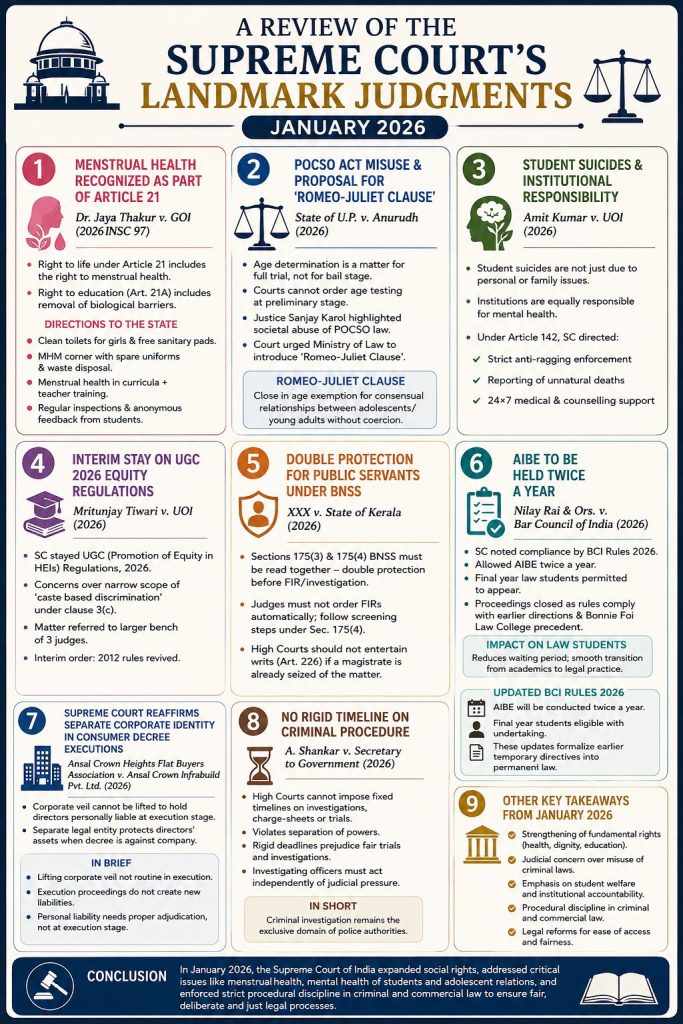
The Supreme Court in January 2026 gave significant judgments balancing constitutional rights, criminal jurisprudence, legal reforms, and education. The court delivered several impactful judgments by affirming fundamental right to menstrual health, introducing crucial guidelines to BNSS, limiting state power, addressing UGC guidelines and many more. This article provides a short brief of all of them.
Menstrual health recognized as part of article 21 : Dr. Jaya Thakur v. GOI (2026 INSC 97)
Facts
Millions of young girls in India face ‘menstrual poverty’, meaning they lack basic access to clean toilets, running water and affordable sanitary pads. Nearly 23 million girls drop out of school every year once they begin menstruating due to lack of hygienic facilities.
Dr. Jaya Thakur, a social activist and medical professional, filed a PIL under Article 32. She argued that forcing girls to choose between their biological needs and their education violates basic human dignity.
Issues Involved
- Does the lack of basic menstrual hygiene management (MHM) and a separate toilets in schools violate girls’ right to life and dignity under Article 21?
- Does ‘menstrual poverty’ create a biological disadvantage for girls which denies their right to education under Article 21A?
- Does failure to provide these basic needs discriminate against female students, thereby violating the right to equality under Article 14?
Judgment
The division bench composed of Justice J.B. Pardiwala and Justice R. Mahadevan, held that the right to life under Article 21 includes the right to menstrual health. It stated that menstrual hygiene is an essential component of human dignity. Similarly, the right to education under Article 21A goes beyond just school admission. It includes the exclusion of biological barriers through mandatory inclusion of free sanitary pads, and proper sanitation all over the campus.
Supreme court issued directions to the state –
- Schools must provide clean, separate toilets for girls with free access to sanitary pads.
- Schools must have clean, functional and gender-segregated toilets.
- Every school should have a Menstrual Hygiene Management (MHM) corner with spare uniforms and waste disposal.
- Menstrual health should be added to school curricula in NCERT & SCERT alongside training for teachers.
- Regular school inspections should be done by authorities and they must collect anonymous feedback from students to fix the necessary needs.
POCSO Act Misuse & Proposal for ‘Romeo-Juliet Clause’ : State of U.P. V. Anurudh (2026)
Facts
- The mother of a girl child filed a kidnapping complaint against a young boy, claiming that her daughter was a 12 year old minor.
- Conflicting age proof emerged during the investigation. A school certificate of the victim stated an older age, which conflicted with the birth certificate.
- The high court ordered a medical age determination test of the victim’s age. The medical board found the victims aged between 18 to 20 years. Based on this report the high court acquitted the accused.
Issues Involved
- Whether the court can conclusively decide the exact age of a victim during a bail hearing, or does it require a full trial?
- Can high court force age testing at the preliminary stage of the case?
Judgment
The Supreme court clarified that the age determination of the victim is a matter for full trial rather than the bail stage. The court set aside the high courts directives and held that, courts cannot force age testing at preliminary stage.
The court also highlighted the societal abuse of POCSO law. Justice Sanjay Karol stated that parents often manipulate their daughters’ age to intentionally penalise the young men involved in consensual adolescent relationships.
Considering this abuse of law, courts emphasised the ministry of law to introduce ‘Romeo-Juliet Clause’.
What is the Romeo-Juliet Clause?
A Romeo-Juliet Clause is a ‘close in age exemption’ used in criminal law. The clause decriminalizes the consensual sexual activity between two adolescents or an adolescent and young adult. Provided they are close in age and there is absolutely no element of coercion. As Indain law has a strict consent age of 18, the law treats a consensual romantic relationship between two 17 year olds as a statutory rape. The court insisted on this reform to create an exemption for close in age, so that consensual adolescent relationships could be protected from harsh criminalization.
Student suicides & Institutional responsibilty : Amit Kumar v. UOI (2026)
Facts
Two B.Tech students at IIT delhi from SC category tragically passed away by suicide in their hostel rooms in 2023. The families alleged that their children faced systematic, caste-based harassment from faculty and students. They accused the institution of ignoring their problems.
The Delhi police refused to file an FIR for murder, stating it was simply an academic stress. After their appeal was dismissed by the high court, the families approached the supreme court. The court formed a National Task Force (NTF) to investigate institutional discrimination and mental health distress across the country.
Issue Involved
Whether higher educational institutions have a fundamental constitutional obligation to maintain safe, inclusive and discrimination free campus, or can they frame individual suicide purely as personal issue?
Judgment
The supreme court emphasized student welfare and human rights by addresseing the cause behind the student suicides in higher education. Court stated that student suicide is a crucial issue and its not just beacuse of family or personal problems. Institutions are equally responsible for the mental health of the students. Court exercising its power under Article 142, to do complete justice, gave directions of strict enforcement of anti-ragging, reporting of unnatural deaths and 24*7 medical and counselling support to the students.
Interim stay on UGC 2026 equity regulations : Mritunjay Tiwari v. UOI (2026)
Facts
In January 2026, the University Grant Commission (UGC) introduced new rules called the Promotion of Equity in Higher Education Institutions Regulations, 2026. These rules were created to tackle caste-based discrimination in colleges. Under clause 3(c) of these rules, ‘caste based discrimination’ was strictly defined as bias against students from reserved categories such as SC, ST, OBC.
Mritunjay Tiwari and others challenged the rules in supreme court. They argued that the definition was too narrow as it only protected reserved students. They question the protection of unreserved categories if they face caste-related biasness.
Issue Involved
Does clause 3(c) of the 2026 UGC rules is unconstitutional as it protects caste discrimination only against specific groups?
Judgment
- The Supreme Court stayed the University Grants Commission (Promotion of Equity in Higher Education Institutions) Regulations, 2026. The court noted concerns regarding the narrow scope of ‘caste based discrimination’ under clause 3(c).
- In order to remove discrepancy an interim order of reviving 2012 UGC equity regulations rules has been passed by the court.
- The court referred the case to a larger 3 judges bench.
Double protection for public servants under BNSS : XXX v. State of Kerala
Facts
- A criminal complaint containing serious allegations of sexual offenses was filed against certain police officers. The question arose whether the offence by police occurred while they were performing their official public duties.
- The complainant alleged the JMFC has delayed registering an FIR. Complainant argued that registering an FIR is mandatory when a serious cognizable offense as stated under Lalita Kumari judgment.
- Therefore, the complainant filed a writ petition before the high court to bypass the initial judicial stages mandated under section 175(4) of BNSS.
Issues Involved
- Whether the high court can entertain writ petitions under article 226 to directly order an FIR when a judicial magistrate is already handling the case?
Judgement
In this case the supreme court for the first time interpreted section 175 of Bharatiya Nagarik Suraksha Sanhita, 2023 (BNSS). The court clarified that sections 175(3) and 175(4) must be read together, establishing a double protection mechanism before an FIR or investigation against a public servant.
The court even asked judges to not automatically order police reports (FIRs) without proper review. They must follow all initial screening steps under section 175(4). It ruled that high courts should not entertain writ petitions under article 226 if a magistrate is already handling the case.
AIBE to be held twice a year : Nilay rai & ors. V. Bar Council of India (2026)
Facts
- The Bar council of India issued a notification stating that only final year law students who had already received their official law degrees or marksheets could register for All India Bar Examination (AIBE).
- As the universities all over India delay in providing final year results, it wasted an entire year of the students.
- Facing the same issue, Nilay Rai along with other law students from Delhi University. Filed a PIL under Article 32 in the supreme court. They argued that BCI’s rule is unfair and goes against the previous supreme court ruling in Bar Council of India v. Bonnie Foi Law College (2023).
Issues Involved
- Is the BCI rule strictly demanding a final year degree or official marksheet for AIBE registration of students unconstitutional?
- Does the rule violate the right to practice a profession under article 19(g) of law students?
Judgement
The Supreme court directed the BCI to hold the All India Bar Examination (AIBE) twice a year and permitted final year law students to sit for the exam. The court ruled that although the final year students can sit for the exam, they’ll get their Certificate of Practice (COP) on the completion and update of their final degree.
The court closed the proceedings after confirming the new regulations satisfy past directions and comply with the Bonnie Foi Law College precedent.
Supreme court reaffirms separate corporate identity in consumer decree executions : Ansal Crown Heights Flat Buyers Association V. Ansal Crown Infrabuild Pvt. Ltd. (2026)
Facts
- A homebuyer association filed consumer complaints against a real estate company (ACIPL) as the builder failed to deliver possession of their flats in the ‘Ansal Crown Heights’ project within the promised timeline.
- The National Consumer Commission (NCDRC) ruled in favour of the buyers. However, before the order could be executed, the building company went into insolvency.
- As the buyers couldn’t get their money back from the company they directly sued directors and promoters of the company to compensate them from their personal funds.
Issues Involved
Whether the consumer forum can lift the separate legal identity of the company and hold its directors and promoters personally liable when the company becomes insolvent?
Judgment
The court dismissed the buyer’s appeal. It ruled that the company has a separate legal identity. Therefore, courts cannot lift the corporate veil to hold directors personally liable during the execution stage of the case. The court affirmed that because the forum issued the decree only against the company, its separate legal identity protects the directors’ personal assets from creditors.
In brief the supreme court has reaffirmed the following –
- The doctrine of lifting the corporate veil cannot be routinely invoked during execution proceedings.
- Execution proceeding does not create new liabilities against parties not in the original suit.
- Courts must establish personal liability through proper adjudication, not at the execution stage.
No rigid timeline on criminal procedure : A. Shankar v. Secretary to government (2026)
Facts
- A. Shankar, popularly known as ‘Savukku Shankar’, an independent media activist, had 37 criminal cases registered against him.
- Shankar filed a writ petition in Madras high court stating that the police commissioner is abusing power, by creating fabricated cases against him.
- The cases were fabricated in order to shut down his news agency known as Savukku Media. Thus, he requested the high court intervention to stop this harassment.
- The high court dismissed his claims on insufficient evidence and ordered the police to do expeditious investigations of his other pending cases. This order worsened his situation even more and ruined his right to fair defense.
- Therefore he approached the supreme court to protect his right to fair trial.
Issues Involved
Whether the high court, while dealing writ petition under article 226 have the legal authority to set strict deadlines of police investigations or criminal trials?
Judgement
The court sets aside the high court ruling. It ruled that the high court cannot impose fixed timelines on police investigations, charge-sheet filings, or criminal trials, as this violates the separation of powers. Court affirmed that rigid deadlines are a prejudice of fair trials and investigations.
It stated the investigating officers must act independently of judicial pressure. In short, the supreme court reaffirmed that criminal investigation remains the exclusive domain of police authorities.
Conclusion
The Supreme court of India in January 2026, delivered historic rulings and expanded social rights by addressing the issues like menstrual health, mental health of students and adolescent relations. At the same time, it also enforced strict procedural discipline in criminal and commercial law to ensure fair deliberate legal processes. Ultimately, landmark judgments of January 2026 show that the supreme court had fully committed to expanding personal liberties, and acted as a guardian to the constitution by making checks and balances in order to ensure fairness.
Get case-law updates weekly
Join 10,000+ subscribers.
JU
Julie Nigam
Contributing author
Have a doubt about this judgment?Ask Doubts