
The word contract comes from the Latin term “Contractum,” meaning “to bring together.” Salmond described it as an agreement that creates and defines an obligation between two or more people, giving one party the right to demand an act or forbearance from another..
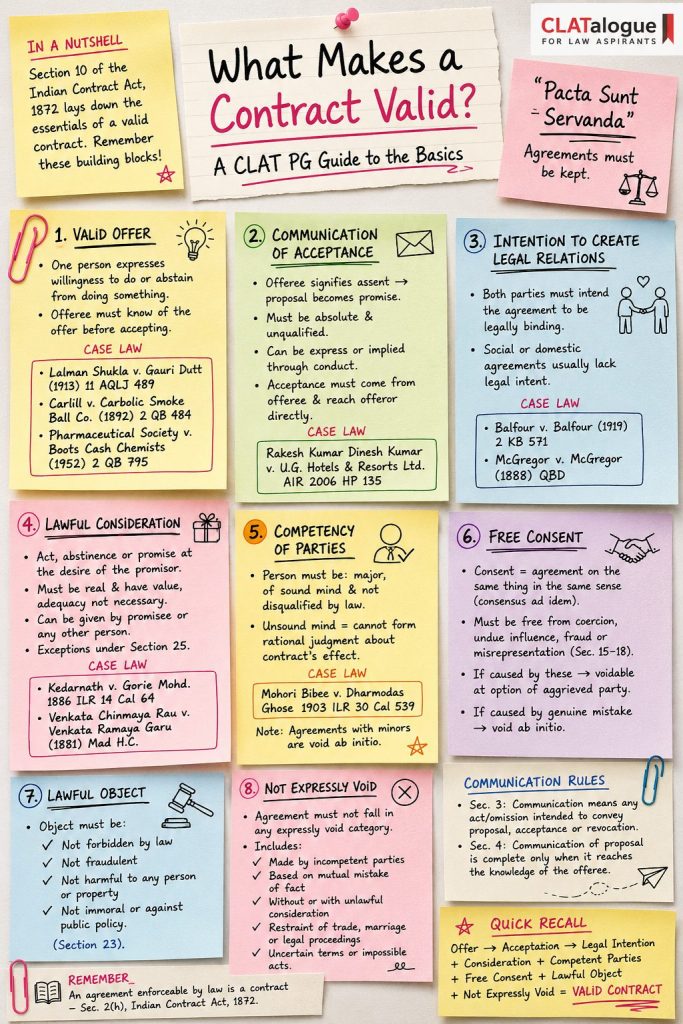
Contract law rests on the Latin maxim Pacta Sunt Servanda, meaning “agreements must be kept.” Once parties strike a deal, they become legally bound to honour it. The Indian Contract Act, 1872, which came into force on September 1, 1872, captures this principle in Section 2(h): an agreement enforceable by law is a contract.
When Does Communication Actually Count?
Section 3 of the Act explains that a proposal, its acceptance, or its revocation is “communicated” through any act or omission by which the party intends to convey it, or which has that effect of conveying it. Section 4 then adds a crucial timing rule: communication of a proposal is complete only when it reaches the knowledge of the person to whom it was made.
The Building Blocks of a Valid Contract
Section 10 of the Indian Contract Act lists out what a valid contract actually requires. These include a valid offer, communication of acceptance, intention to create legal relations, lawful consideration, competent parties, free consent, a lawful object, and the absence of any express declaration of voidness.
Valid Offer
Section 2(a) defines an offer as one person expressing willingness to do or abstain from doing something, to secure the other party’s consent. An offer can technically be made to the whole world, but a contract only comes into existence once someone accepts it. Crucially, the offeree must actually know about the offer before accepting it.
Lalman Shukla v. Gauri Dutt (1913) 11 AQLJ 489 illustrates this well. A servant searched for his employer’s missing nephew without knowing that a reward had been announced for finding him. When he later learned of the reward and tried to claim it, the Allahabad High Court refused, holding that mere performance without knowledge of the offer cannot amount to acceptance.
Contrast this with Carlill v. Carbolic Smoke Ball Co. (1892) 2 QB 484, where a company advertised a reward to anyone who caught the flu after using their product as instructed. Mrs Carlill did exactly that and fell ill anyway, and the court held the advertisement was a valid unilateral offer binding on the company, even though it wasn’t directed at any specific person.
One more nuance worth remembering: displaying goods in a shop is not an offer to sell. In Pharmaceutical Society of Great Britain v. Boots Cash Chemists (1952) 2 QB 795, the court clarified that picking up an item is the customer’s offer to buy, and the sale only completes once the shopkeeper accepts that offer at the counter.
Communication of Acceptance
Section 2(b) states that acceptance happens when the offeree signifies assent to the proposal, turning it into a promise. Acceptance must be absolute and unqualified. The moment a person adds a new condition while “accepting,” that response stops being an acceptance and becomes a counter-offer instead, which the original offeror must separately accept.
Acceptance can be expressed in words or implied through conduct, as seen in Rakesh Kumar Dinesh Kumar v. U.G. Hotels and Resorts Ltd. AIR 2006 HP 135 There, the defendant’s conduct of settling accounts and making partial payment showed implicit acceptance of the plaintiff’s terms, even without a formal written response. The court treated this behaviour as sufficient acceptance.
It’s also worth noting that communication of acceptance must come from the offeree himself and reach the offeror directly. Acceptance conveyed through an unauthorised third party carries no legal effect.
Intention to Create a Legal Relationship
Black’s Law Dictionary defines agreement as a meeting of understanding and intention between parties regarding their rights and duties. For an agreement to mature into a contract, both sides must intend it to be legally binding. Purely social or domestic arrangements, however sincere, generally don’t create enforceable obligations.
Balfour v. Balfour (1919) 2 KB 571 remains the go-to authority here. A husband promised his wife a monthly allowance, but when the marriage broke down and she sued to enforce it, the court held that domestic arrangements between spouses typically lack the intention needed for legal enforceability.
Compare this with McGregor v. McGregor (1888) QBD, where a couple settled ongoing legal complaints through mutual promises, and the court enforced the agreement because both parties clearly intended it to bind them legally.
Lawful Consideration
Section 2(d) defines consideration as an act, abstinence, or promise made at the desire of the promisor, and it may come from the promisee or any other person. Without consideration, a promise becomes a bare or gratuitous promise, known in Latin as Nudum Pactum, and is generally unenforceable.
A few rules matter here: consideration must be given at the promisor’s desire, must hold some real value, and need not be adequate in amount. Indian law also departs from English law’s privity of consideration doctrine, allowing a third party to furnish consideration on behalf of a contracting party.
Section 25 lists exceptions where agreements without consideration remain valid, covering promises made out of natural love and affection, promises to compensate someone for a past voluntary act, and promises to pay a time-barred debt. Kedarnath v. Gorie Mohd. 1886 ILR14 Cal64 , the well-known town hall case, held that subscribers who pledged money for construction, knowing a contractor would be engaged on the strength of their pledge, had furnished valid consideration.
Venkata Chinmaya Rau v. Venkata Ramaya Garu (1881) Mad H.C. further confirms that Indian law rejects privity of consideration. A daughter who received her mother’s estate promised to pay an annuity to her mother’s sister, and even though the sister wasn’t party to the original arrangement, the court enforced her right to the annuity.
Competency of the Parties
Section 11 sets three conditions for contractual capacity: the person must be a major, of sound mind, and not otherwise disqualified by law. Section 12 clarifies that a person is of unsound mind if, at the time of contracting, they cannot form a rational judgment about how the contract affects their interests.
The landmark Mohori Bibee v. Dharmodas Ghose 1903 ILR 30 Cal 539 settled that agreements with minors are void from the very beginning, not merely voidable. A moneylender who advanced funds against a minor’s mortgage could not recover the amount through the contract. However, a guardian entering into a contract on a minor’s behalf can create a binding obligation, and the minor can also ratify certain agreements upon attaining majority.
Free Consent
Consent exists when two or more parties agree upon the same thing in the same sense, a concept known as consensus ad idem, or “meeting of minds.” If consent is procured through coercion, undue influence, fraud, or misrepresentation under Sections 15 to 18, the resulting agreement becomes voidable at the option of the aggrieved party rather than automatically void.
Where the flawed consent stems from a genuine mistake, however, the agreement is void from the outset. Mere silence about facts doesn’t usually amount to fraud, unless the silent party owed a duty to speak or the circumstances made silence equivalent to a false statement.
Lawful Object and Contracts Not Expressly Void
Section 23 bars agreements built on unlawful objects, including anything forbidden by law, fraudulent arrangements, agreements harming a person or property, and anything the court considers immoral or against public policy.
Finally, a contract must not fall into any expressly void category. This includes agreements made by incompetent parties, those built on a mutual mistake of fact, agreements lacking consideration or unlawful consideration and agreements restraining trade, marriage, or legal proceedings. Agreements with uncertain terms or those requiring an impossible act also fail on this last essential.
(This piece breaks down the essentials of a valid contract under the Indian Contract Act, 1872, with the case law CLAT PG aspirants are expected to know. Bookmark it for quick revision before your next mock.)
Subscribe for updates
Join 10,000+ subscribers.
HA
Hanspal Bakul
Contributing author
Have a doubt about this?Ask Doubts