
CLAT PG 2027 Reform: Recommendations From the CLAT Expert Committee Report Explained
The Consortium of National Law Universities set up an Expert Committee in September 2025 to review and reform the Common Law Admission Test. The Committee submitted its Final Report on 2nd February 2026, and it proposes major changes to the CLAT PG exam that are expected to be implemented from 2027. If you are preparing for CLAT PG or simply want to understand how the postgraduate law entrance exam is set to change, this blog breaks down every recommendation in simple terms.
Who Was on the CLAT Expert Committee
The Committee was chaired jointly by Prof. Dev Saif Gangjee (University of Oxford) and Prof. Tarunabh Khaitan (LSE School of Law) as Co-Convenors. Other members included Prof. Shyamkrishna Balganesh (Columbia Law School), Prof. Pritam Baruah (BML Munjal University), and Prof. Surabhi Ranganathan (University of Cambridge). The Committee was formed after a resolution by the Consortium’s Advisory Board, chaired by Justice Indu Malhotra (Retd.), and it studied comparable law entrance exams like the LSAT and LNAT before finalising its suggestions.
Why CLAT PG Needed Reform
The report points out that the CLAT PG exam has faced repeated criticism for poor question quality and litigation. In 2025 alone, eight questions in the PG paper were challenged in the Delhi High Court. The Consortium withdrew five of them, and the Court found two more to be clearly incorrect. Similar complaints had also come up in 2020, showing that this is a recurring problem rather than a one time mistake.
Beyond errors, the Committee found that many PG questions tested only rote memory. Candidates were often asked to recall trivial details such as the name of a dissenting judge or the year a tribunal was set up, instead of being tested on legal reasoning or the ability to apply principles. Passages were also getting longer each year, with the word count jumping by around 66 percent between 2023 and 2024, which made the exam more about reading speed and endurance than actual understanding of the law.
The Committee also flagged a fairness issue that is unique to the PG exam. Since candidates apply for many different LLM specialisations, such as intellectual property law, criminal law, or public law, a single uniform syllabus ends up favouring some specialisations over others. For example, a candidate preparing for a public law track is naturally exposed to subjects that overlap with the general syllabus, while a candidate preparing for an intellectual property track gets no advantage at all.
Key CLAT PG Recommendations From the Report
1. A New Five Section Exam Structure
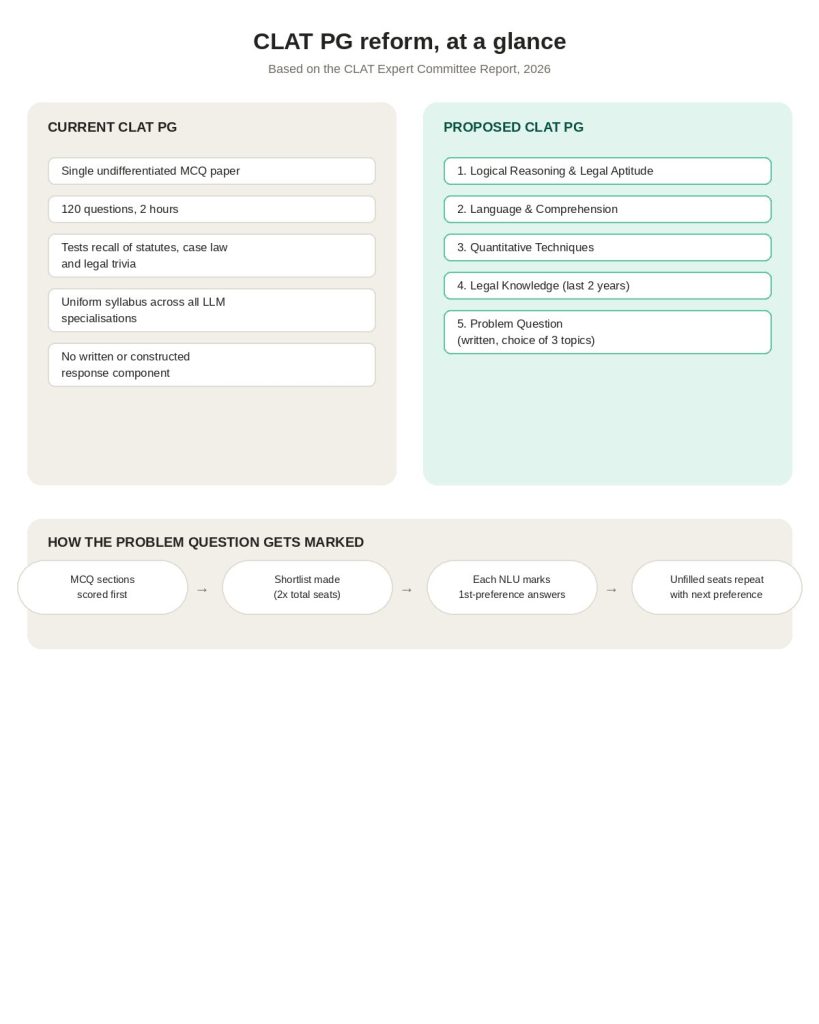
The Committee has recommended a completely restructured CLAT PG paper with five sections instead of a single undifferentiated question set. The new structure includes:
- Logical Reasoning and Legal Aptitude
- Language and Comprehension
- Quantitative Techniques
- Legal Knowledge
- Problem Question (a constructed response section)
The first three sections are the same ones proposed for the reformed CLAT UG exam, but they will carry a combined weightage of only 50 percent in the PG paper. The remaining weight goes to the two new sections built specifically for postgraduate level assessment.
2. A New Legal Knowledge Section
This multiple choice section is meant to test a candidate’s understanding of important legal concepts and recent legal developments in India and internationally. The Committee has been clear that this section should test depth of understanding rather than legal trivia. Questions on the names of committees, judges, or exact case dates are discouraged. Instead, the focus will be on legal principles, doctrine, and how they are applied.
To keep the syllabus manageable, the Committee suggests that current legal developments should be limited to the two calendar years immediately before the exam. This is meant to reduce the sheer volume of preparation material and cut down the role of luck in scoring well.
3. A New Problem Question Section With Constructed Responses
This is one of the most significant changes proposed for CLAT PG. Instead of only multiple choice questions, candidates will now face a written, constructed response section. Here is how it would work:
- Candidates get a choice of three legal problems drawn from Public Law, Private Law, Commercial Law, or International Law.
- Each problem is based broadly on an important legal development from the two years before the exam, though candidates can draw on foundational principles from any time period.
- The section tests two specific skills: structured legal reasoning, meaning the ability to identify relevant legal principles and apply them systematically to given facts, and lucid articulation, meaning the ability to communicate that analysis clearly and to address counterarguments.
4. How the Problem Question Will Actually Be Assessed
Given that thousands of students take CLAT PG every year, marking every single written answer was seen as impractical. The Committee has proposed a smart, staged evaluation process to solve this:
- Only the multiple choice sections are marked first. Based on these scores, a global shortlist is created that is twice the size of the total number of available seats across all NLUs.
- In round one, each NLU marks the Problem Question answers only for candidates on the shortlist who ranked that NLU as their first preference. Based on this, each NLU finalises its list of accepted candidates.
- Any NLU that still has empty seats moves to round two, where it marks the answers of shortlisted candidates who ranked it as their second preference.
- This process repeats through further rounds until every seat at every NLU is filled.
This approach limits the number of essays each university has to evaluate while still keeping the written component central to the final selection.
5. Time Limit and Number of Questions
The Committee recommends that each of the first four sections should contain no more than 10 to 15 questions. The entire exam, including the written Problem Question, should be completed within 2 hours. The idea behind this is to reward thoughtful, considered answers rather than speed.
6. Retaining the Entrance Exam Instead of Other Admission Methods
The Committee also considered whether CLAT PG should be replaced with methods used abroad, such as evaluating undergraduate grades or asking for a statement of purpose. It decided against this for a few clear reasons:
- The number of applicants in India is far larger than in most foreign universities, making a written exam more practical at scale.
- Undergraduate law degree evaluation is not standardised across Indian universities, so comparing grades fairly is difficult.
- Statements of purpose and writing samples have become unreliable indicators of ability due to the growing use of AI tools by applicants.
7. The Unresolved Problem of Specialised LLM Programmes
The Committee openly admits that it could not fully solve the issue of specialised LLM courses. Building a separate, bespoke CLAT paper for every LLM specialisation was seen as logistically very difficult in the near term. As a middle ground, the report recommends a single PG entrance exam for all candidates but with a choice of Problem Questions from clearly defined, fundamental areas of law. The idea of designing separate specialised exams has been left open for consideration at a later date.
What Has the Consortium Finalized for CLAT 2027?
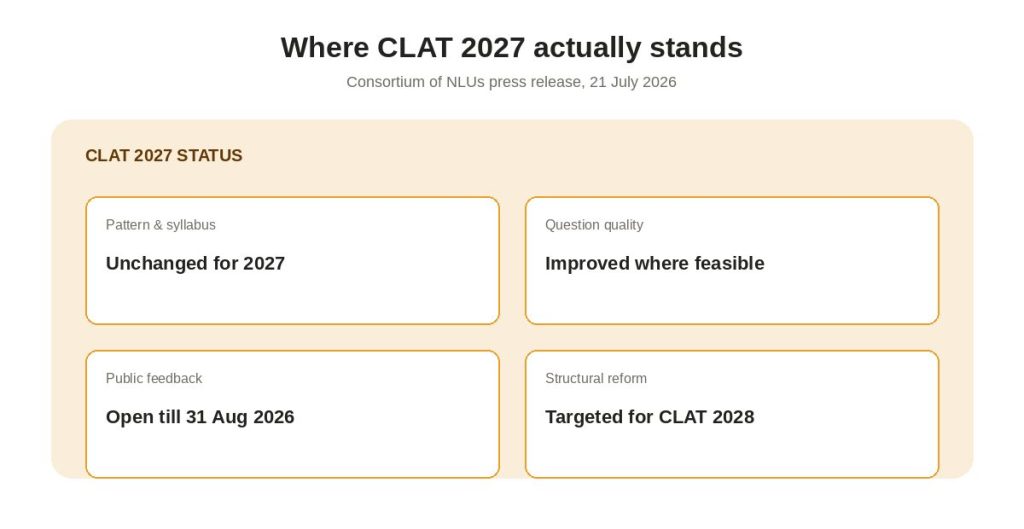
On July 21, 2026, the Consortium of National Law Universities put out an official update settling the question of what CLAT 2027 will actually look like. The headline takeaway is straightforward: the syllabus, exam pattern, and section structure for both the UG and PG papers will stay exactly as they are. Nothing is changing for the 2027 cycle.
This should come as welcome news to anyone who had been anxious that the Expert Committee’s proposals might be rolled out overnight, upending preparation plans with little notice.
That does not mean the report has been shelved, though. The Consortium has indicated that whoever sets the CLAT 2027 papers, meaning the Convenor and the paper-setting team, will be encouraged to work in the spirit of the Committee’s suggestions where doing so is practical, particularly around how questions are framed and how error-free they are. So while the overall shape of the exam is staying put, candidates might still notice a paper that feels somewhat more polished and less prone to the kind of ambiguity the report criticised.
Here is a quick snapshot of where things currently stand:
| Point | Consortium’s Position |
| CLAT 2027 Pattern | Unchanged for both UG and PG papers. |
| CLAT 2027 Syllabus | Unchanged for both UG and PG papers. |
| UG CLAT Sections | Existing five-section format continues as is. |
| PG CLAT Structure | Existing pattern and syllabus remain in place. |
| Question Format & Quality | Paper setters may draw on Expert Committee suggestions where practical. |
| Expert Committee Report | Being made public so stakeholders can weigh in. |
| Feedback Window | Open until August 31, 2026. |
| Longer-Term Reforms | Any structural changes are being pushed to the CLAT 2028 cycle, pending feedback. |
What This Means for CLAT PG Aspirants
For CLAT PG 2027, aspirants can continue preparing under the existing exam format, since the section structure, syllabus, and overall pattern remain unchanged for this year. There is no need to shift preparation strategy around the new five section model discussed above just yet.
That said, the direction of reform is now clear. Paper setters have been asked to improve question format and quality within the current structure, so candidates may still notice fewer verbatim or ambiguous questions and a slightly greater emphasis on reasoning, even within the old pattern. The bigger structural changes, including the new Legal Knowledge section and the constructed response Problem Question, are being positioned for CLAT 2028 onward, depending on the feedback the Consortium receives by August 31, 2026.
Students, educators, and parents who wish to share their views on the Expert Committee’s recommendations can do so through the Consortium’s official feedback form before the deadline.
The CLAT Expert Committee Report is a strong signal that the Consortium of National Law Universities wants to move CLAT PG away from rote learning and towards genuine legal aptitude and reasoning. The introduction of a written Problem Question section, a sharper Legal Knowledge section, and a more structured, staged evaluation process could make the exam fairer and more meaningful for postgraduate legal education. However, the Consortium’s July 2026 decision confirms that these changes will not apply to CLAT 2027, and the current pattern will continue for one more year. The real test of these reforms will come with CLAT 2028, once public feedback has been considered and the Consortium takes a final call on implementation.
Subscribe for updates
Join 10,000+ subscribers.
SH
Shruti chauhan
Contributing author
Have a doubt about this?Ask Doubts