
From Jantar Mantar to Justice : Critical Analysis of The Public Examinations (Preventions of Unfair Means) Amendment Act, 2026.
In India, a large number of students prepare for government exams, not only government but various competitive exams like JEE, NEET, CLAT etc. They burn the midnight oil to prepare for these exams, in the hope to succeed. When the question paper leaks, it deeply harm their mental destory the trust they have placed in the government.
The Public Examinations (Preventions of Unfair Means) Amendment Bill, 2026 is India’s most aggressive legislative attempt to end the crisis of competitive exam paper leak. Dr. Jitendra Singh on 27th July, 2026 introduced the bill in Lok Sabha. Lok Sabha passed it on July 29th, and Rajya Sabha on July 30th, 2026. It got presidential assent on July 31, 2026 and came into effect.
This amendment updates the parent 2024 Act in direct response to 2026 Jantar Mantar students protests triggered by the massive NEET-UG 2026 paper leak and cancellation.
Law students and CLAT-PG/UG aspirants, must study this legislation to understand the constitutional background, statutory provisions and its socio-legal implications.
History and Background – The Public Examinations (Preventions of Unfair Means) Act, 2024.
The Public Examinations (Preventions of Unfair Means) Act, 2024 was enforced on June 21, 2024, to serve as India’s first central law for anti-cheating. It brought central testing bodies such as – NTA, UPSC, SSC, IBPS and Railway Recruitment Boards, under a uniform legal umbrella.
The 2024 act aimed at eliminating 15 specific malpractices, including unauthorised access to question papers, tampering with OMR Sheets, and computer network manipulation. It provided the punishment of 3 to 5 years of imprisonment for individuals and up to 10 years for organised crime and exam-fraud syndicate.
The 2026 NEET Crisis & Jantar Mantar Protests
Despite the 2024 Act, there was severe system failure. The boiling point arrived on 3rd May, 2026, when the NEET-UG exam was questioned on account of the widespread paper leak, ultimately forcing its cancellation. This institutional failure led to the mental health crisis among students, resulting in 12 tragic student suicides before the re-exam could be taken.
These deaths sparked anger across the country. Youth groups like the Cockroach Janta Party(CJP) and several other students unions, thousands of students and their families took over Jantar Mantar in New Delhi.
These protests rapidly spread all over India, resulting in shutting down of major metro stations, shutting down of the internet and the historic resignation of Union Education Minister Dharmendra Pradhan on July 25, 2026.
In order to calm down the massive youth protests, the Union Cabinet quickly introduced the 2026 Amendment Bill.
Need for an Amendment
The Public Examinations Act, 2024 law had 3 major legal and administrative flaws which led to the need of an amendment.
- Weak Punishment – The original penalties were not strong enough to stop rich, highly organized, multi-state cheating mafias.
- Judicial delays – Normal legal procedures took years to resolve, leaving the futures of millions of innocent students stuck in uncertainty.
- Lack of company accountability – Technology providers and private test centres owners escaped criminal liability by blaming the administration for clerical errors.
Comparative Analysis of 2024 Act and 2026 Amendment Act
| Statutory Provisions and Criteria | Public Examinations Act, 2024 | 2026 Amendment Act |
| Punishment for Individuals | 3 to 5 years imprisonment, fine up to rupees 10 lakhs | 5 to 10 years imprisonment, fine up to rupees 50 lakh |
| Organised exam crime | 5 to 10 years imprisonment, minimum fine of 1 crore | Minimum 7 to 10 years imprisonment, fine up to 10 crore. |
| Tech service providers | Fine up to 1 crore, recovery of proportional exam costs. | Fine up to 5 crore, strict debarment for 8 years. |
| Investigation Timeline | No statutory time-limit. | Mandatory completion within 2 months. |
| Trial Timeline | Regular criminal court timeline applies | The trial should be completed within 3 months of the chargesheet. |
| Judicial Mechanism | Regular session courts. | Special fast-track courts. |
| Appeals to | Followed standard hierarchical criminal appeals. | Direct appeal to the Division Bench of the High Court. |
All the offences under both the acts remain cognizable, non-bailable, and non-compoundable.
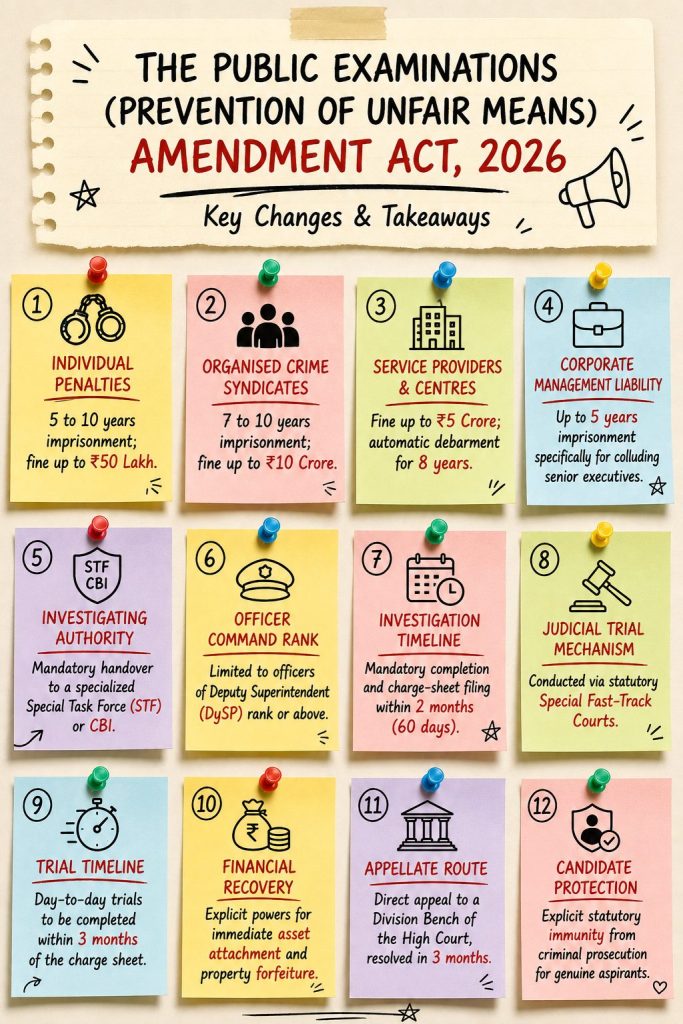
How the 2026 law will help the society and students
The statutory provisions of 2026 law aims to transition India from a reactive system to deterrent system –
- Stopping the profit from leaks – By increasing fines to 10 crore and allowing the government to seize the property and assets of corrupt organizations, the law takes away the financial reward of high paper leaks.
- Ending legal delays – Setting up official fast-track courts ensures that culprits are convicted within months. If the accused has multiple charges under BNS or any other law, it will be treated by the fast-track courts under the same trial.
- Using technology to protect exams – The law legally requires testing agencies to modernise their systems. They must now use Aadhar based biometrics, AI face recognition, strict security checks and fully encrypted digital networks to send out exam papers securely.
- Immunity for candidates – the law explicitly isolates genuine aspirants from criminal prosecution, treating them as victims of the system rather than wrongdoers.
- Inclusion of Special Task Force – The specialised STF and CBI ensures transparency and speedy investigations. The STF & CBI operates pan-India which allows them to bypass state laws and arrests and raids across multiple states.
Socio-Legal Impact on Institutional Challenges
For CLAT aspirants, analysing the bill critically requires evaluating both its positive impacts and legal challenges –
Positive Impact on Society
- This initiative aims to rebuild trust in public institutions and reassure youth that the law will protect their honest hard work.
- Making exams secure creates a fair chance for everyone, reducing socio-economic disadvantage.
- As a central statute, this law provides a legal template to the state government to restructure and secure their local examinations, including state PSC and similar state exams.
Legal Challenges
- Legal experts argue that the law focuses too much on punishing criminals after a leak has already happened. It fails to fix systemic security beforehand, such as unverified test centers and weak online security.
- The government cannot rely solely on strict penalties, it must physically tighten security at printing factories and delivery trucks to stop cheating.
- Mandating 2 month investigations and 3 months trial is quite impossible as India has an extreme shortage of judges, prosecutors and forensic investigators. Fulfillment of this timeline will also hamper the quality of evidence.
Conclusion
Ultimately, this amendment strengthens the Public Examinations Act, 2024, by making exam paper leak and its malpractices a severe, non-bailable offence. Also, it strictly safeguards the innocent candidates from wrongful prosecution. By aligning with article 14 and article 21 it ensures to provide fair access to public employment and addresses student mental health crisis. Overall, it marks a vital step towards restoring public trust and protecting student dignity.
Subscribe for updates
Join 10,000+ subscribers.
JU
Julie Nigam
Contributing author
Have a doubt about this?Ask Doubts