
Defection or Merger? Understanding Paragraph 4 of the Tenth Schedule
Six Shiv Sena (UBT) MPs have crossed over to the Shinde camp, and the question of whether this counts as a genuine “merger” is now before the Supreme Court. For CLAT PG aspirants, it’s a live test of how far Paragraph 4 of the Tenth Schedule really stretches.
The Trigger
On 22nd June 2026, six Lok Sabha MPs from Uddhav Thackeray’s Shiv Sena (UBT) shifted to Eknath Shinde’s faction, claiming their numbers met the two-thirds threshold for a valid merger. Speaker Om Birla agreed and recognised the merger, cutting the party’s Lok Sabha strength from nine MPs to three.
The Legal Question
Shiv Sena (UBT) argues that Paragraph 4 requires a merger of the original political party, not just its legislative wing. A group of MPs, they say, cannot merge a party on their own. They can only accept or reject a merger the party itself has initiated.
So the real question is this: can a two-thirds legislative majority be the merger, or does it always need the parent party’s consent?
The Tenth Schedule (Anti-Defection Law), added by the 52nd Amendment (1985), deals with disqualification of legislators on grounds of defection under Articles 102(2) and 191(2). A member gets disqualified if he voluntarily gives up party membership or votes against party whip without prior permission/condonation within 15 days.
Why Paragraph 4 Exists
The Tenth Schedule punishes legislators who switch sides for personal gain. Paragraph 4 is a narrow exception. If two-thirds of a legislative party agrees to merge with another party, none of them faces disqualification.
The problem is telling a genuine political realignment apart from a convenient legislative headcount.
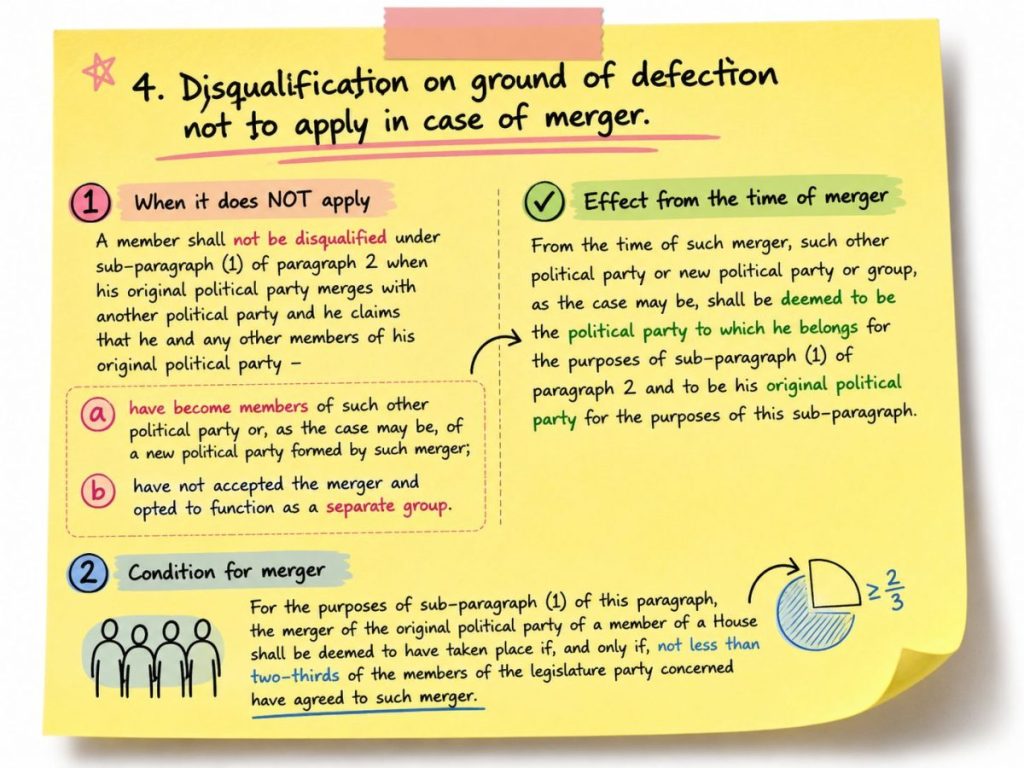
Source: 10th schedule to the Indian Constitution
Two Precedents to Know
Girish Chodankar v. Speaker, Goa Assembly (2022) held a two-thirds breakaway group can validly merge. Subhash Desai v. Principal Secretary, Maharashtra (2023) went further. It held that after Paragraph 3’s deletion, a legislative split alone is no defence. The real party must be identified by its constitution and leadership, not by numbers.
Subhash Desai itself grew out of the 2022 Shiv Sena split, making this dispute feel like a sequel.
Where It Stands
The Supreme Court issued notice on 22nd July 2026 in a plea by MP Arvind Ganpat Sawant, but declined interim relief. Senior advocate Devadatt Kamat urged the bench to treat it as a matter of constitutional importance.
Does Paragraph 4 protect legislators the moment numbers cross two-thirds, or does it need a real merger at the party’s organisational core? No matter which way the Court leans, this case looks set to shape the future of anti-defection law, and it’s a strong pick for CLAT PG 2027.
Subscribe for updates
Join 10,000+ subscribers.
HA
Hanspal Bakul
Contributing author
Have a doubt about this?Ask Doubts