
Emergency Provisions Under the Constitution of India: A Complete Guide to Article 352-360
Every constitution needs a safety valve, a clause that says, in effect, “if things fall apart, here’s how the government holds itself together.” For India, that safety valve is Part XVIII of the Constitution, Articles 352 to 360, commonly known as the Emergency Provisions.
What Is an “Emergency” Under the Constitution?
In ordinary times, India functions as a federal country where powers are divided between the Centre and the States. But the Constitution’s framers, having lived through Partition and communal violence, wanted a mechanism that could convert this federal structure into a unitary one during a crisis, at least temporarily.
Dr. B.R. Ambedkar defended this design by pointing out that no federation could survive a genuine crisis without some flexibility to centralize power. Critics call it one of the most controversial parts of the Constitution, since history shows it can be and has been misused.
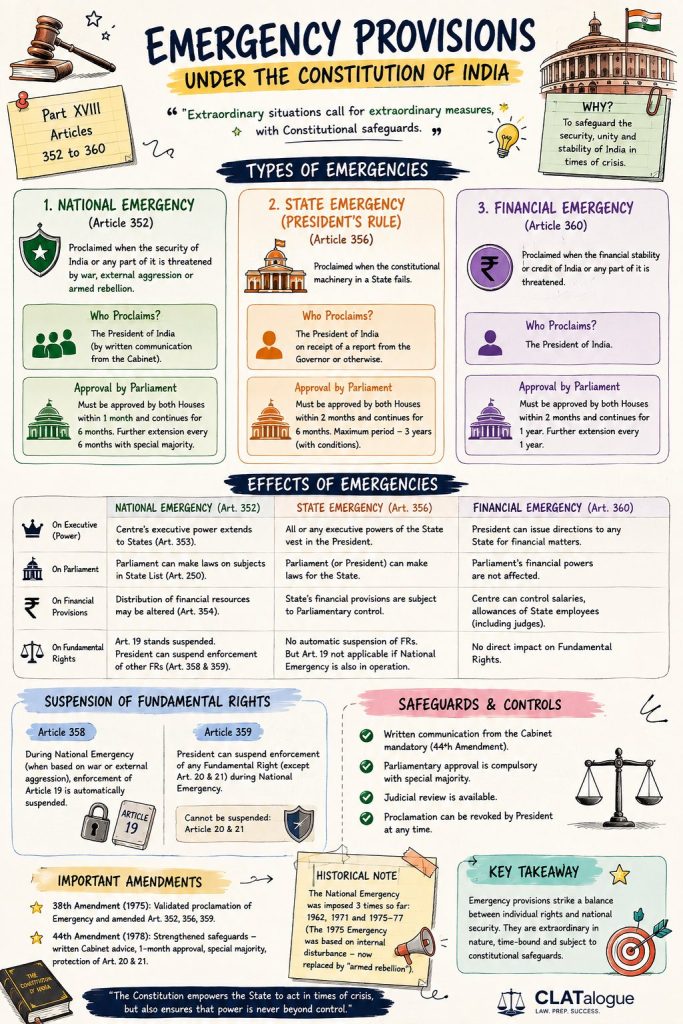
There are three types of emergencies under the Indian Constitution:
- National Emergency under Article 352
- President’s Rule (State Emergency) under Article 356
- Financial Emergency under Article 360
Let’s go through each one.
1. National Emergency (Article 352)
Grounds for Declaration
The President can declare a National Emergency if satisfied that the security of India, or any part of it, is threatened by war, external aggression, or armed rebellion.
The original word used in the Constitution was “internal disturbance,” but the 44th Amendment Act, 1978 replaced it with “armed rebellion,” which is a much narrower and stricter ground. This change came directly out of the backlash against the 1975 Emergency, which had been declared on the vague ground of internal disturbance.
A National Emergency can be declared for the whole country or for any part of it, since this “any part” clause was also added by the 44th Amendment.
Procedure
The President can act only on the written recommendation of the Union Cabinet, a post-1975 safeguard added by the 44th Amendment so that one individual, even the Prime Minister, cannot single-handedly trigger an emergency.
The proclamation must then be approved by both Houses of Parliament within one month. Once approved, it stays in force for 6 months and can be extended indefinitely, six months at a time, with fresh parliamentary approval each time.
This approval requires a special majority, meaning a majority of the total membership of each House along with a majority of not less than two-thirds of members present and voting.
Effects of National Emergency
This is where most exam questions come from. A National Emergency affects the country in three major ways.
A. Centre-State Relations. The Union Parliament gets the power to legislate on subjects in the State List too, so the federal structure effectively becomes unitary.
B. Life of the Lok Sabha and State Assemblies. Parliament can extend the normal 5-year term of the Lok Sabha by one year at a time, though not beyond 6 months after the emergency ends.
C. Fundamental Rights. This is the part students most often get wrong, so let’s break it down carefully.
Under Article 358, the moment a National Emergency is declared on the grounds of war or external aggression (not armed rebellion), the six Fundamental Rights under Article 19 are automatically suspended for the duration of the emergency.
Under Article 359, the President can, by a separate order, suspend the right to move any court for the enforcement of Fundamental Rights, except for Articles 20 and 21, which can never be suspended. This too was a 44th Amendment safeguard, introduced following the ADM Jabalpur controversy.
The ADM Jabalpur Case and Why It Matters
In ADM Jabalpur v. Shivkant Shukla (1976), decided during the 1975 Emergency, the Supreme Court controversially held that even the right to life and personal liberty under Article 21 could be suspended during an emergency, and that citizens had no remedy to approach courts even if illegally detained. This judgment is widely regarded as one of the darkest moments in Indian judicial history. It was effectively overturned by the 44th Amendment, which made Articles 20 and 21 non-suspendable, and was later formally disapproved by a 9-judge bench in K.S. Puttaswamy v. Union of India (2017).
Instances of National Emergency So Far
India has seen a National Emergency three times:
| Year | Ground | Notes |
| 1962 | External aggression (China war) | First proclamation |
| 1971 | External aggression (Pakistan war) | Second proclamation |
| 1975 | Internal disturbance | The infamous “Emergency” under Indira Gandhi that led to the 44th Amendment safeguards |
2. President’s Rule / State Emergency (Article 356)
Grounds
Article 356 allows the President to take over the administration of a State if satisfied that its government cannot be carried on in accordance with the provisions of the Constitution. This satisfaction can arise from a report of the Governor of the State, or from other information available to the President that is independent of the Governor’s report.
Article 365 is closely linked here. If a State fails to comply with directions given by the Union, the President can presume that a situation has arisen where the State government cannot function constitutionally.
Procedure
The proclamation must be approved by both Houses of Parliament within 2 months. Once approved, it lasts 6 months and is extendable up to a maximum of 3 years, with parliamentary approval every 6 months.
Beyond one year, any extension requires additional conditions to be met, such as a National Emergency being in operation, or the Election Commission certifying that elections cannot be held. This too is a 44th Amendment safeguard.
Effects
The President takes over the executive functions of the State, and the Governor administers on the President’s behalf. Parliament assumes the State Legislature’s powers to make laws, and the State Legislative Assembly is either dissolved or kept in suspended animation.
The S.R. Bommai Case, the Most Important Case on Article 356
S.R. Bommai v. Union of India (1994) is the single most important judgment on this topic and appears in almost every exam. A 9-judge bench held that the President’s proclamation under Article 356 is subject to judicial review, and that the floor of the House, not the Governor’s subjective opinion, is the proper place to test whether a government has lost its majority.
It further held that if the proclamation is struck down by courts, the dissolved Assembly can be revived, and that Article 356 must be used sparingly, as a measure of last resort, rather than to settle political scores with State governments run by opposition parties.
This judgment significantly curbed the earlier misuse of Article 356, which had been invoked well over 100 times before Bommai, often to dismiss opposition-led State governments.
3. Financial Emergency (Article 360)
Grounds
The President can declare a Financial Emergency if satisfied that the financial stability or credit of India, or any part of its territory, is threatened.
Procedure
The proclamation must be approved by both Houses of Parliament within 2 months. Once approved, it has no maximum duration and can continue indefinitely until revoked.
Effects
The Union can give directions to any State to observe specified canons of financial propriety. Salaries and allowances of all government employees, including judges of the Supreme Court and High Courts, can be reduced, and money bills passed by State legislatures can be reserved for the President’s consideration.
Has It Ever Been Used?
No. A Financial Emergency has never been declared in India, not even during major economic crises like 1991 or 2008. This is a favourite trick question in exams, since many students assume it must have been used at some point, but it hasn’t.
Comparison Table
| Feature | National Emergency (Art. 352) | President’s Rule (Art. 356) | Financial Emergency (Art. 360) |
| Ground | War, external aggression, armed rebellion | Failure of constitutional machinery in a State | Threat to financial stability or credit |
| Recommended by | Union Cabinet (written) | Governor’s report or other information | President’s satisfaction |
| Parliamentary approval within | 1 month | 2 months | 2 months |
| Initial duration | 6 months | 6 months | No fixed duration |
| Maximum duration | Indefinite (6 months at a time) | 3 years (with conditions after 1 year) | Indefinite |
| Times invoked | 3 (1962, 1971, 1975) | 100+ times | 0 (never) |
| Key case | ADM Jabalpur (1976) | S.R. Bommai (1994) | Not applicable |
Judicial Review of Emergency Provisions
A recurring exam theme is whether courts can review the President’s satisfaction in declaring an emergency.
Before the 38th Amendment, courts could review the President’s satisfaction freely. The 38th Amendment (1975) made the President’s satisfaction final and non-justiciable, a direct product of Emergency-era politics.
The 44th Amendment (1978) deleted this bar and restored judicial review. Then, in Minerva Mills v. Union of India (1980), the Supreme Court struck down the part of the 42nd Amendment that had tried to make the President’s satisfaction immune from judicial review, holding that judicial review is part of the basic structure of the Constitution and cannot be excluded.
So today, the President’s proclamation of emergency can be challenged in court, though only on the ground of mala fide exercise of power or that the satisfaction was based on wholly extraneous or irrelevant grounds, not on the correctness of the decision itself.
Why the 44th Amendment Matters So Much
Almost every safeguard in the current emergency provisions traces back to the 44th Constitutional Amendment Act, 1978, passed after the Janata Party government came to power following the unpopular 1975 to 1977 Emergency. These five changes are worth remembering, since they turn up in exams often:
- “Internal disturbance” was replaced with “armed rebellion”
- Emergency can now be revoked if the Lok Sabha passes a resolution by simple majority disapproving it, whereas earlier only the President could revoke it
- A written recommendation of the Cabinet was made mandatory before declaring a National Emergency
- Articles 20 and 21 cannot be suspended even during an emergency
- Judicial review of the President’s satisfaction was restored
Conclusion
The Emergency Provisions represent the Constitution’s built-in tension between stability and liberty, a mechanism designed to protect the nation in a crisis but one capable of undermining the very democracy it’s meant to preserve if left unchecked.
Understanding this topic isn’t just about memorising article numbers. It’s about understanding why India’s post-1975 constitutional history added so many layers of safeguards around a power that, in the wrong hands, can override federalism, suspend rights, and dissolve elected governments.
For exam purposes, anchor your understanding around three things: the grounds for each type of emergency, the procedural safeguards that followed the 44th Amendment, and the two landmark cases, ADM Jabalpur and S.R. Bommai, since between them they explain almost everything about how far Indian courts will go in checking emergency powers.
Subscribe for updates
Join 10,000+ subscribers.
SH
Shruti chauhan
Contributing author
Have a doubt about this?Ask Doubts