
Judicial Review Under the Constitution of India: Meaning, Provisions, and Case Law
Judicial review gives courts the power to examine whether a law, an executive action, or even a constitutional amendment stands consistent with the Constitution. If it does not, the court can strike it down. This single power sits at the heart of how India’s Constitution protects itself, and it explains why the judiciary can act as a check on both Parliament and the government rather than simply following their decisions.
If you are preparing for any law entrance test, this topic appears almost every year, often paired with the Basic Structure Doctrine.
What Is Judicial Review
Judicial review means the power of the higher judiciary, meaning the Supreme Court and the High Courts, to examine the constitutionality of legislative enactments and executive orders. If a law or an executive action violates any provision of the Constitution, particularly the Fundamental Rights, the court can declare it void.
Interestingly, the phrase “judicial review” never actually appears anywhere in the text of the Constitution. The framers embedded the power implicitly through several provisions rather than naming it directly, and courts later developed it into the full doctrine we recognise today. This is one of the most commonly tested facts on this topic, so it is worth remembering exactly as it is.
Origin of the Concept
The concept of judicial review did not originate in India. It traces back to the United States, where the Supreme Court asserted this power for itself in the landmark case of Marbury v. Madison in 1803, even though the American Constitution does not expressly grant it either. India’s framers, aware of this precedent, wove a similar power into the Constitution through express textual provisions, giving Indian courts a foundation that American courts originally had to infer on their own.
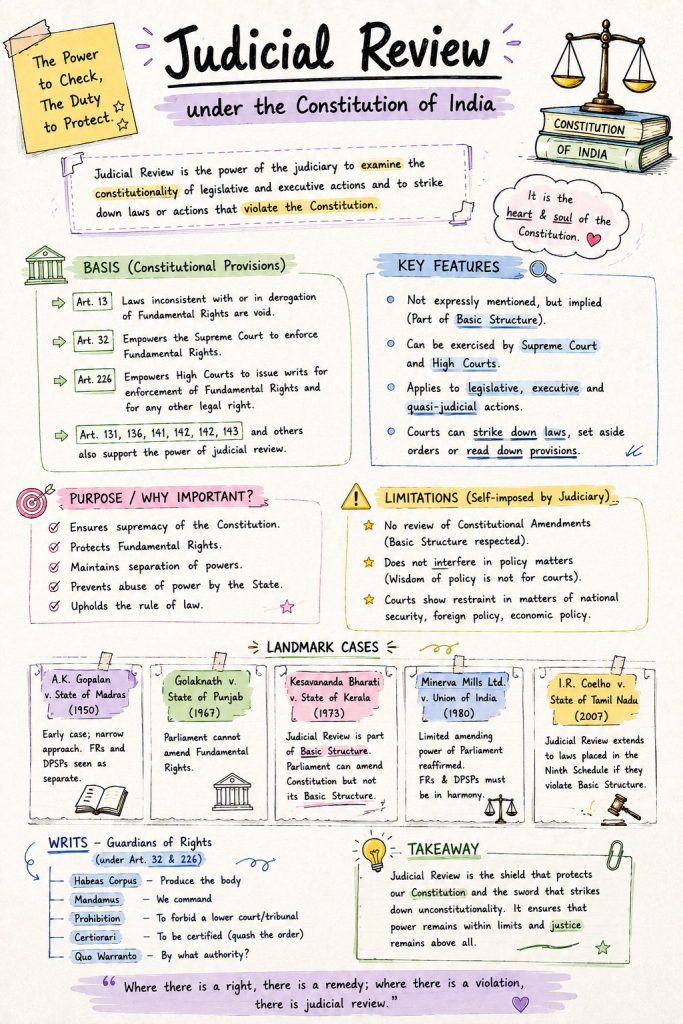
Constitutional Provisions on Judicial Review
Several articles together form the foundation of judicial review in India, and students often lose marks by naming only one or two of them. Here is each provision explained on its own.
Article 13: The Foundational Provision
Article 13 declares that any law inconsistent with or in derogation of the Fundamental Rights shall be void to the extent of that inconsistency. This single article gives courts the constitutional authority to strike down any law that violates Part III of the Constitution, and it is generally treated as the starting point of judicial review in India.
Article 32: The Right to Constitutional Remedies
Article 32 empowers individuals to move the Supreme Court directly for the enforcement of Fundamental Rights, and the Court can issue writs such as habeas corpus, mandamus, prohibition, certiorari, and quo warranto for this purpose. Dr. B.R. Ambedkar called this the heart and soul of the Constitution, precisely because it turns judicial review into something citizens can actually invoke rather than a power courts exercise only on their own.
Article 226: The Power of High Courts
Article 226 gives High Courts a similar and even wider power to issue writs, not only for enforcing Fundamental Rights but also for any other legal purpose. This extends judicial review beyond Fundamental Rights matters and down to the state level, making it broader in scope than Article 32.
Articles 131 to 136: Original and Appellate Jurisdiction
These provisions outline the Supreme Court’s original, appellate, and advisory jurisdiction, which often requires the Court to interpret constitutional provisions while settling disputes between the Centre and the states, between states, or in appeals from lower courts.
Articles 245 and 246: Legislative Competence
Article 245 deals with the territorial extent of laws made by Parliament and state legislatures, while Article 246 governs the distribution of legislative powers between them through the Union, State, and Concurrent Lists. Courts frequently rely on these two articles to test whether a particular law falls within the competence of the legislature that passed it.
Articles 251 and 254: Repugnancy Between Laws
Article 251 and Article 254 deal with the supremacy of Parliamentary law over state law in case of a conflict on subjects in the Concurrent List. These provisions give courts an additional ground to examine and, where necessary, invalidate a state law that conflicts with central legislation.
Article 372: Continuance of Pre-Constitutional Laws
Article 372 provides for the continuance of laws that existed before the Constitution came into force, but only to the extent that they remain consistent with it. Courts use this article to test whether old, pre-independence laws still hold constitutional validity today.
Article 368: The Amending Power and Its Limits
Article 368 grants Parliament the power to amend the Constitution, but courts have consistently held that this power is not absolute. Even a constitutional amendment must respect certain core features of the Constitution, and this is exactly where the Basic Structure Doctrine enters the picture.
Judicial Review and the Basic Structure Doctrine
This is the single most important connection you need to understand for any exam on this topic. Judicial review is not just a power courts exercise. It is itself considered a part of the basic structure of the Constitution, which means Parliament cannot remove or dilute it even through a constitutional amendment.
Landmark Cases That Shaped Judicial Review
Shankari Prasad v. Union of India (1951)
This was one of the earliest cases on the question. The Supreme Court held that Parliament’s power to amend the Constitution under Article 368 included the power to amend Fundamental Rights as well, and that such amendments could not be challenged under Article 13.
Golaknath v. State of Punjab (1967)
An 11-judge bench reversed the earlier position, holding that Parliament could not amend Part III of the Constitution to take away or abridge Fundamental Rights, treating a constitutional amendment as “law” within the meaning of Article 13. This created considerable tension between Parliament and the judiciary and eventually pushed the government toward the 24th Amendment, which tried to restore Parliament’s unrestricted amending power.
Kesavananda Bharati v. State of Kerala (1973)
This case settled the debate and remains the most significant case on this entire topic. A 13-judge bench, the largest ever assembled by the Supreme Court, held that Parliament has wide power to amend the Constitution, including Fundamental Rights, but this power does not extend to altering the Constitution’s “basic structure.” The Court did not define this basic structure exhaustively, but it later came to include federalism, secularism, the separation of powers, the rule of law, and judicial review itself.
Indira Nehru Gandhi v. Raj Narain (1975)
Often called the Election Case, this judgment applied the doctrine directly. The Supreme Court struck down a clause inserted through the 39th Amendment that tried to place election disputes involving the Prime Minister outside the jurisdiction of all courts, holding that this violated the basic structure by removing judicial review from a matter it was meant to cover.
Minerva Mills v. Union of India (1980)
This case reinforced the doctrine further. The Court struck down provisions of the 42nd Amendment that attempted to give Directive Principles precedence over Fundamental Rights and that tried to place constitutional amendments beyond judicial review entirely. The Court held clearly that judicial review is part of the basic structure and cannot be excluded by Parliament under any circumstances.
Kihoto Hollohan v. Zachillhu (1992)
This case dealt with the Tenth Schedule, inserted by the 52nd Amendment to address political defections. The Court upheld most of the anti-defection provisions but held that a clause barring judicial review of the Speaker’s decisions on disqualification was unconstitutional, since it violated the basic structure.
L. Chandra Kumar v. Union of India (1997)
The Court held that the power of judicial review vested in the High Courts under Articles 226 and 227 and in the Supreme Court under Article 32 forms an integral and essential feature of the Constitution, constituting part of its basic structure. It ruled that tribunals could not function as substitutes for High Courts and the Supreme Court in matters of constitutional interpretation, since that would strip away a basic feature of the Constitution.
Supreme Court Advocates on Record Association v. Union of India (2015)
Popularly known as the NJAC case, this judgment struck down the National Judicial Appointments Commission Act and the 99th Constitutional Amendment that created it. The Court held that the new mechanism for judicial appointments compromised judicial independence, which it treated as inseparable from an effective system of judicial review.
Shreya Singhal v. Union of India (2015)
This case applied judicial review in a more everyday context. The Supreme Court struck down Section 66A of the Information Technology Act for being vague and for having a chilling effect on free speech under Article 19(1)(a), showing how judicial review protects individual rights against ordinary legislation, not just against constitutional amendments.
Scope of Judicial Review in India
Judicial review in India covers considerable ground, and it helps to see this scope broken into three categories.
Legislative actions. This includes ordinary laws passed by Parliament and state legislatures, constitutional amendments, ordinances issued under Articles 123 and 213, and delegated legislation such as rules, regulations, and bye-laws.
Executive actions. This covers administrative orders, notifications, and policy decisions taken by the Central government, state governments, and other public authorities.
Judicial and quasi-judicial decisions. Courts can also review decisions of subordinate courts and tribunals through their appellate and supervisory jurisdiction, ensuring that these bodies stay within their constitutional and statutory limits.
Why Judicial Review Matters
Judicial review protects the supremacy of the Constitution by ensuring that no law or government action can override it. It safeguards Fundamental Rights by giving citizens a direct and enforceable remedy whenever those rights are violated. It maintains the balance of power between the legislature, the executive, and the judiciary, preventing any single organ of the state from becoming too powerful.
It has also driven significant social reform, from striking down discriminatory laws to expanding the meaning of rights like privacy and personal liberty through judicial interpretation over the decades.
Criticism and Limitations
Judicial review is not free from criticism. Excessive use of this power can slow down governance and delay policy implementation, since courts sometimes examine matters that arguably belong to the domain of elected legislatures. Critics also raise concerns about judicial overreach, where courts appear to step into policy making rather than simply interpreting the law.
There is no fixed, written definition of what exactly constitutes the basic structure, which gives courts considerable discretion and occasionally invites the charge that judicial review lacks predictable boundaries. Because of these tensions, courts themselves have repeatedly stressed the importance of judicial restraint, exercising this power only where a genuine constitutional violation exists rather than routinely second guessing legislative or executive choices.
Judicial review stands as one of the Constitution’s most powerful self protective mechanisms. It began as a set of scattered provisions meant to safeguard Fundamental Rights and gradually grew, through decades of case law, into a doctrine so fundamental that Parliament itself cannot remove it.
For exam purposes, anchor your understanding around three things: the actual constitutional provisions that support judicial review, the evolution from Shankari Prasad through Golaknath to Kesavananda Bharati, and the cases that later confirmed judicial review as part of the basic structure. Once these three pieces fit together, the rest of the topic tends to fall into place naturally.
Subscribe for updates
Join 10,000+ subscribers.
SH
Shruti chauhan
Contributing author
Have a doubt about this?Ask Doubts