
Often students find jurisprudence a challenging subject to study. It becomes deeply engaging when we recognize that its true purpose is to serve humanity, As justice V.R. Krishna Iyer beautifully noted “ the roots of jurisprudence lie in the soil of society’s needs, and its bloom in the nourishment from the humanity it serves.” Meaning justice is not rigid, rather a living concept driven by human empathy and societal needs.
This article talks about the meaning of jurisprudence, its origin, definitions of prominent jurists, its relation with other social sciences and comparative tables on their ideas.
Meaning
In simple terms jurisprudence is the study of law. The word jurisprudence is derived from the latin term ‘Jurisprudentia’. If we further break down the term ‘jurisprudentia’ into ‘juris’ and ‘prudentia’, we’ll see the meaning to them, ‘juris‘ means ‘of law’ and ‘prudentia’ means ‘knowledge or skill’. Thus, in a broader sense jurisprudence means the knowledge of law.
Although there is no such static definition of jurisprudence. There are various jurists like Austin, Salmond, Kelsen, Benthem and many more who have defined jurisprudence according to their philosophical ideas.
Important Definitions of Jurisprudence
Some of the most essential and frequently cited definitions of jurisprudence by famous jurists are provided below. In the next article we’ll learn about their school of thought.
John Austin
Austin defined jurisprudence as the ‘philosophy of positive law’. Positive law refers to the rules set by a political superior i.e. the sovereign, to govern political inferiors, backed by sanctions.
He explicitly separated ‘law it is’ the positive law from ‘the law as it ought to be’ the morality. For Austin, jurisprudence is actually the formal study of actual, existing legal principles created by political superiors.
Thomas Erskine Holland
He defined jurisprudence as the ‘formal science of positive law’. He argued that jurisprudence deals with the structural concepts of legal relations rather than the actual material content of specific laws.
Jeremy Bentham
He defines jurisprudence as the examination of law, which he defines into two branches – expository jurisprudence (what the law is) and censorial jurisprudence (what the law ought to be).
Bentham, the father of modern utilitarianism, believes that the ultimate purpose of law is to promote ‘the greatest happiness of the greatest number’. His approach to jurisprudence was designed to systematically dissect existing laws to maximise human pleasure and minimize pain.
Cicero
Cicero conceptually defined jurisprudence as the knowledge of law rooted in true philosophy, right reason, and the science of justice. For him, jurisprudence can never be separated from philosophy, ethics, and human nature. To understand jurisprudence, one must study the nature of humanity and the universe.
Ulpian
Defined jurisprudence broadly as “ the knowledge of things divine and human, the science of the just and the unjust.” Ulpian’s classical definition reflects the ancient Roman viewpoint that law, morality, and religion were deeply interlinked.
Ulpian connected this definition directly to three fundamental maxims of law –
- To live honorably (honeste vivere).
- To harm no one (alterum non laedere).
- To render to each his own (ssum Cuique tribuere)
John Salmond
He defined jurisprudence as ‘the science of law’. He further classified it into two distinct senses, a ‘generic’ i.e. the science of civil law as a whole and a ‘specific’ sense i.e. the analysis of the principles of civil law.
Salmond brought a structured, analytical approach to legal theory. He bridges the gap between strict legal positivism and practical legal systems by focusing his definition entirely on civil law. Civil law refers to the laws actually enforced by courts of justice.
Roscoe Pound
Pound defined jurisprudence as the science of ‘social engineering’. He used the engineering metaphor to explain that the purpose of jurisprudence is to study how the law can be constructed and applied for the smooth functioning of society.
He rejected the ideas of Austin that law is just a static set of rules and Cicero’s abstract moral concept.
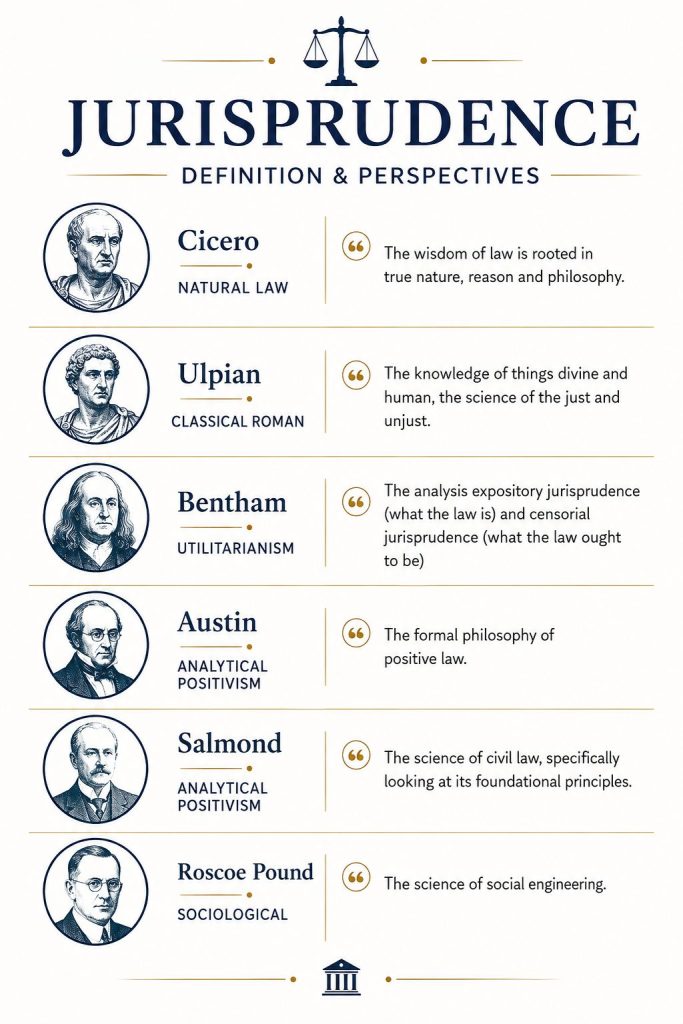
Comparative analysis of jurist’s definition
| Jurist | School of thought | Definition of Jurisprudence |
| Cicero | Natural Law | The wisdom of law is rooted in true nature, reason and philosophy. |
| Ulpian | Classical Roman | The knowledge of things divine and human, the science of the just and unjust. |
| Bentham | Utilitarianism | The analysis expository jurisprudence (what the law is) and censorial jurisprudence (what the law ought to be) |
| Austin | Analytical Postivism | The formal philosophy of positive law. |
| Salmond | Analytical Postivism | The science of civil law, specifically looking at its foundational principles. |
| Roscoe Pound | Sociological | The science of social engineering. |
Why do we need to study ‘Jurisprudence’?
People often think that jurisprudence has no practical applicability as it is more of theory rather than procedure. However this is a major misconception. While procedural laws tell us ‘how to apply the law’, jurisprudence explains ‘what law actually is, where it comes from, and why it exists.’
Almost all active statutory laws and judicial procedures are built directly upon the theories discovered in jurisprudence.
Studying this subject is essential for several practical reasons –
- It is often said to be the eye of law. Just like human eyes allow us to navigate the physical world, jurisprudence gives lawyers the vision to navigate complex legal issues.
- One cannot predict the future. When new technologies or social changes create legal gaps where no legislation exists, lawyers and judges rely on jurisprudence to invent fair and logical solutions.
- It trains the lawyers and law students to think logically by understanding rights, duties, liabilities concepts.
- It helps the judiciary and lawyers to ascertain the true meaning of any act or legislation by providing the rules of interpretation.
- By connecting law to morality, history and sociology it reminds legal professionals that the ultimate goal of any rule is to serve human justice.
Jurisprudence and its relationship with other Social Sciences
Different branches of knowledge are deeply connected and cannot be studied alone because they all examine human actions from different angles. Jurisprudence stands closely linked with social sciences like history, psychology, ethics, and sociology.
Legal scholars state that to truly understand the core of law, legal professionals must work together with these other social fields.
Jurisprudence and Sociology
Jurisprudence and sociology are deeply interconnected because they both study human behaviour and social systems, but they approach the law from different perspectives. While a practical lawyer focuses strictly on applying legal rules, a sociologist looks closely at the people who create, enforce, and are affected by those laws within a society.
Practically, this relationship is vital for lawmaking, legal reforms, and judicial decisions. As seen in the field of criminology, where sociology has shifted the legal focus from punishing a criminal to reforming the criminal.
Jurisprudence and Psychology
Jurisprudence and Psychology are closely linked through human behaviour. Law regulates outward actions, while psychology studies the inner human mind. Lawmakers and lawyers must understand mental patterns while making, enforcing, and interpreting laws.
Jurisprudence and Ethics
Jurisprudence and Ethics are closely related as both deal with standards of human conduct, though they approach it differently. Ethics defines what is morally right or wrong, serving as the foundation for creating just and fair laws. The key difference between the two is law regulated external behaviour and carries legal punishments, whereas ethics guides personal morals and individuals duties.
Ultimately, while law enforces external order, ethics provides the moral standard that keeps the legal system just and meaningful.
Jurisprudence and Economics
They are deeply linked because financial factors strongly influence human relationships and legal issues. Also, both fields aim to improve the economic and social well-being of the people. Ultimately, while economics drives the material needs of society, law provides the essential framework to regulate wealth and ensure social welfare.
Karl Marx first highlighted the close link between law and economics by showing how financial and material factors shape legal systems.
Jurisprudence and History
Jurisprudence and history are interdependent because we cannot fully understand law without its past context. This connection is so vital that it forms a specific branch of legal study known as the ‘Historical school of Jurisprudence’. Conclusively, history acts as the structural map of the law, providing the vital background and evolution of how current legal systems developed over time.
Jurisprudence and Politics
Jurisprudence and politics share a foundational connection because the state and its government form the backbone of the legal system. It is driven by governmental structures, where politics defines how governments operate, which in turn helps shape how laws are created and carried out.
Conclusively, politics builds the machine that creates and enforces law, while legal theory ensures that power functions within a structured system.
Conclusion
In simple terms, jurisprudence is the study, philosophy, and science of law. It does not look at one specific law, but instead studies what law is, where it comes from, and how it helps society. By analyzing the different definitions from Austion’s sovereign command to Pound’s social engineering it becomes clear that the legal system does not exist in isolation.
Instead jurisprudence acts as a bridge between legal theory and history, politics, economics, ethics, and psychology. It ensures social justice to human society.
Subscribe for updates
Join 10,000+ subscribers.
JU
Julie Nigam
Contributing author
Have a doubt about this?Ask Doubts