
Strict Liability and Absolute Liability under the Law of Torts: Meaning, Essentials, Exceptions & Landmark Cases
Introduction
Modern industries and hazardous activities have increased the risk of accidents that may cause serious harm to people and property. In many cases, victims may find it difficult to prove negligence on the part of the defendant. To address such situations, the law developed the doctrines of Strict Liability and Absolute Liability. These doctrines impose liability even without proof of negligence, but they differ in their scope and application.
The doctrine of Strict Liability originated in English law through the landmark decision in Rylands v. Fletcher (1868). Later, the Supreme Court of India evolved the doctrine of Absolute Liability in M.C. Mehta v. Union of India (1987) to deal with accidents involving hazardous and inherently dangerous industries.
Meaning of Strict Liability
Strict Liability is a principle under which a person is held liable for damage caused by the escape of a dangerous thing from their land, even if they exercised reasonable care and were not negligent.
The doctrine is based on the principle that a person who introduces a dangerous substance onto their land for their own purposes must ensure that it does not escape and cause harm to others. If such an escape occurs, the person is liable for the resulting damage, subject to certain recognised exceptions.
Landmark Case: In Rylands v. Fletcher (1868), the defendant constructed a reservoir on his land. Water escaped through abandoned mine shafts and flooded the plaintiff’s adjoining mine. Although the defendant had not acted negligently, the House of Lords held him liable because he had brought a dangerous thing onto his land that escaped and caused damage.
Illustration: A factory stores large quantities of toxic chemicals in storage tanks. Due to an unforeseen defect, the chemicals leak into neighbouring agricultural land and destroy crops. Even if the factory owner had taken reasonable precautions, they may be held strictly liable if the requirements of the doctrine are satisfied.
Essentials of Strict Liability
For the rule in Rylands v. Fletcher to apply, the following elements must generally be established:
- The defendant brought a dangerous thing onto their land.
- The dangerous thing was accumulated for a non-natural or special use of the land.
- The dangerous thing escaped from the defendant’s land.
- The escape caused damage to the plaintiff.
Exceptions to Strict Liability
Strict Liability is not absolute. The defendant may avoid liability in certain recognised situations, including:
- Act of God: Damage caused solely by extraordinary natural events that could not reasonably be anticipated.
- Act of a Stranger: Damage resulting from the unforeseeable act of an independent third party.
- Plaintiff’s Own Default: The plaintiff’s conduct contributed to or caused the damage.
- Consent of the Plaintiff: The plaintiff voluntarily accepted the risk associated with the dangerous activity.
- Statutory Authority: The activity was expressly authorised by law and carried out within the limits of that authority.
Meaning of Absolute Liability
Absolute Liability is a stricter rule developed by the Supreme Court of India. It applies to enterprises engaged in hazardous or inherently dangerous activities. Such enterprises are liable for any harm resulting from those activities without any exceptions.
The doctrine reflects the view that industries engaged in dangerous operations have a social responsibility to ensure that no harm results from their activities. Since they derive economic benefit from hazardous activities, they must bear the cost of any accidents arising from them.
Landmark Case: In M.C. Mehta v. Union of India (1987), commonly known as the Oleum Gas Leak Case, oleum gas leaked from a factory in Delhi, causing death and injury. The Supreme Court held that enterprises engaged in hazardous activities are absolutely liable for the harm caused and cannot rely on the traditional exceptions available under Strict Liability.
Illustration: A chemical manufacturing company experiences a gas leak due to an unexpected technical failure. Even if the company had followed all prescribed safety standards, it remains liable for the injuries caused because it was engaged in an inherently dangerous activity.
Features of Absolute Liability
The doctrine of Absolute Liability has several distinctive features:
- It applies specifically to hazardous or inherently dangerous industries.
- Proof of negligence is unnecessary.
- The enterprise cannot rely on the traditional exceptions recognised under Strict Liability.
- Compensation should correspond to the size, capacity, and financial strength of the enterprise so that it has a meaningful deterrent effect.
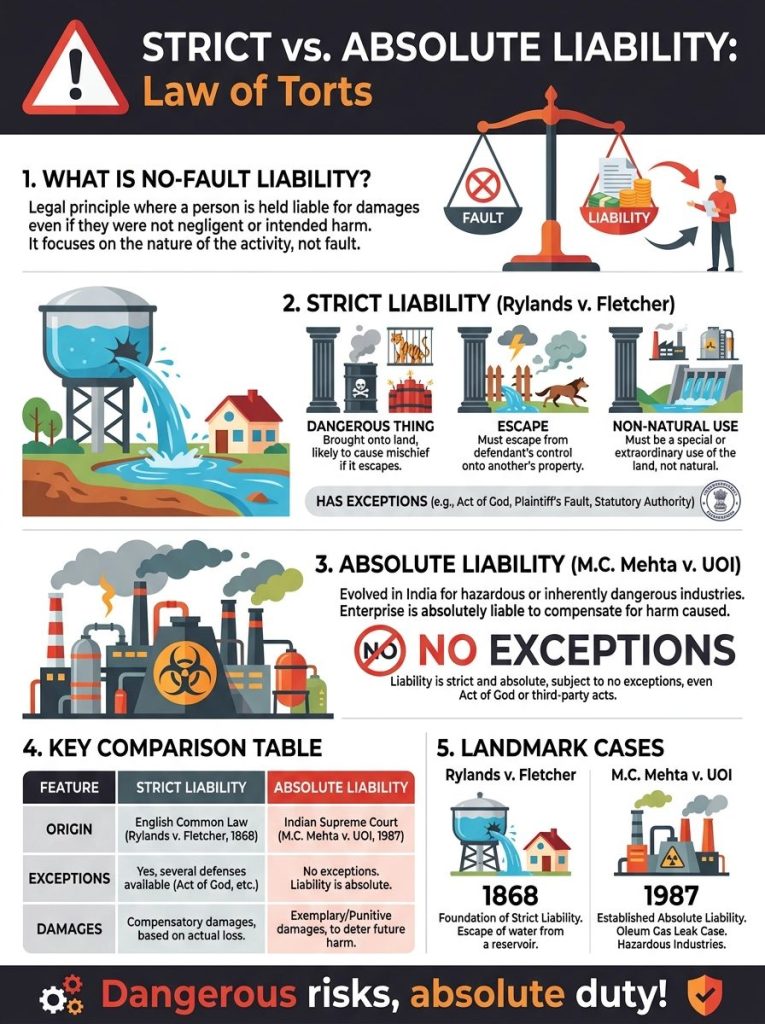
Strict Liability and Absolute Liability: Key Differences
| Basis | Strict Liability | Absolute Liability |
| Origin | English common law | Indian judicial doctrine |
| Leading Case | Rylands v. Fletcher (1868) | M.C. Mehta v. Union of India (1987) |
| Applicability | Escape of dangerous things from land | Harm caused by hazardous or inherently dangerous industries |
| Need to Prove Negligence | Not required | Not required |
| Exceptions | Several recognised exceptions apply | No recognised exceptions |
| Purpose | Protect neighbouring property and persons | Ensure maximum protection and compensation in industrial accidents |
Conclusion
The doctrines of Strict Liability and Absolute Liability represent important developments in the law of torts. Strict Liability introduced the principle that those who keep dangerous substances must bear responsibility if they escape and cause harm. Absolute Liability further strengthened this principle by removing all recognised exceptions for hazardous industries, reflecting India’s commitment to protecting life, health, and the environment in the face of modern industrial risks.
Subscribe for updates
Join 10,000+ subscribers.
SH
Shruti chauhan
Contributing author
Have a doubt about this?Ask Doubts