
Uniform Civil Code in India: What Madhya Pradesh’s New UCC Bill Really Means
On 21 July 2026, something happened in Bhopal that will end up in law school textbooks, exams and debate. Amid slogans, walkouts, and a Congress MLA marching into the well of the House, the Madhya Pradesh Legislative Assembly passed the Madhya Pradesh Uniform Civil Code Bill, 2026 by voice vote.
Chief Minister Mohan Yadav called it a “golden day” for the state’s 8.5 crore people. The Opposition called it a rushed, divisive move that deserved a Select Committee’s scrutiny, not a hurried vote. Both reactions tell you something important: the Uniform Civil Code is no longer a textbook debate. It is now live law, state by state, and it is reshaping how marriage, divorce, and inheritance work for millions of Indians.
If you’re studying for a judiciary exam, prepping for CLAT or UPSC, or you’re simply a citizen trying to understand what changed, this article covers everything in plain language.
What Is the Uniform Civil Code (UCC)?
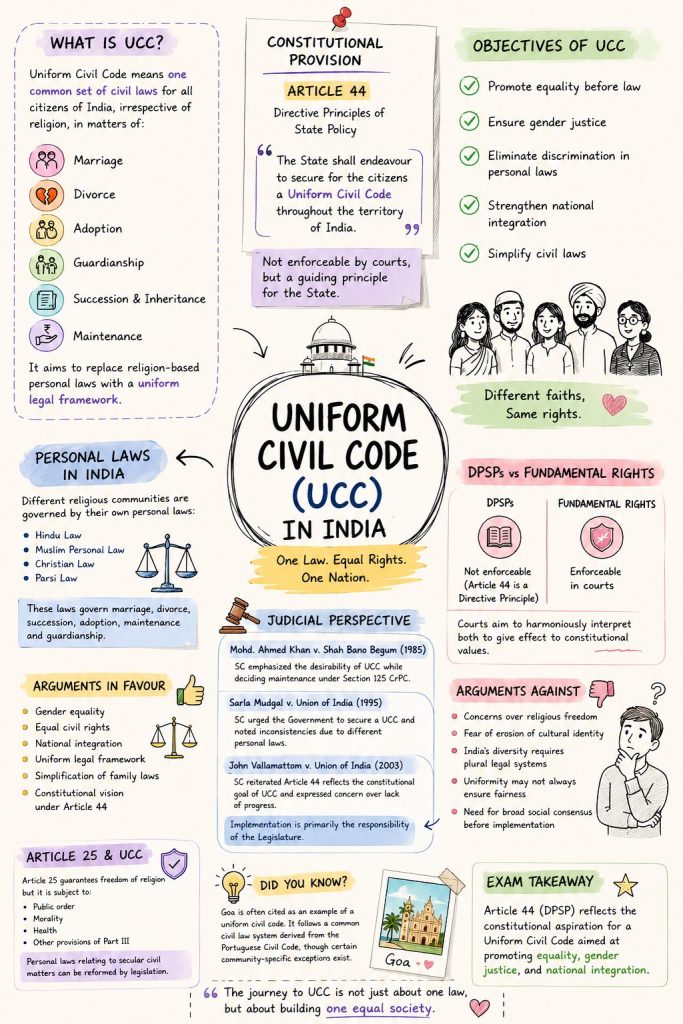
The Uniform Civil Code refers to a single set of civil laws covering marriage, divorce, adoption, inheritance, and succession that would apply to every citizen, regardless of religion. Today, India runs on a mixed system:
- Criminal law is uniform for everyone (the Bharatiya Nyaya Sanhita, earlier the IPC).
- Civil matters like marriage and inheritance are still governed by separate personal laws like Hindu law, Muslim personal law, Christian law, Parsi law, and various customary/tribal codes.
The idea of replacing this patchwork with one common code comes straight from the Constitution. Article 44, part of the Directive Principles of State Policy, directs the State to “endeavour to secure for the citizens a uniform civil code throughout the territory of India.” Unlike Fundamental Rights, Directive Principles aren’t enforceable in court but they’re meant to guide policy. For over seven decades, UCC stayed exactly there: a guiding principle, not a law.
That has changed dramatically in the last two years.
Which States Have Adopted UCC So Far?
Madhya Pradesh isn’t acting alone. It’s the latest entrant in a fast-moving trend of state-level UCC legislation:
- Goa has followed a common civil code since Portuguese colonial rule (1867), applicable to all residents irrespective of religion. Its the original template, though it predates Independence.
- Uttarakhand became the first state after Independence to pass its own UCC Bill, in February 2024, notified in early 2025.
- Gujarat enacted its UCC legislation in March 2026.
- Assam passed its common civil law legislation in May 2026.
- Madhya Pradesh passed its UCC Bill on 21 July 2026, becoming the fourth state post-Independence (fifth if Goa is counted) to adopt a uniform civil law framework.
Notice the pattern that momentum has clearly picked up through 2026. More states, including Rajasthan, are reportedly considering similar legislation. What started as a single-state experiment in Uttarakhand is quickly becoming a multi-state movement.
Inside the Madhya Pradesh UCC Bill, 2026: The Key Provisions
The MP Bill was drafted by a seven-member committee headed by former Supreme Court judge Justice Ranjana Prakash Desai, after what the government describes as consultations with legal experts, political parties, and civil society groups. CM Mohan Yadav described the law as resting on four pillars: marriage, divorce, succession, and live-in relationships.
Here’s what actually changes on the ground:
- Minimum marriage age: 21 years for men, 18 years for women applied uniformly, regardless of religion.
- Polygamy banned outright for all communities, along with a prohibition on practices such as nikah halala.
- Compulsory marriage registration, right down to the village level, with a fine for non-compliance.
- Judicial divorce only and a person cannot remarry without first obtaining a legal divorce from their existing spouse through proper legal proceedings; informal or unilateral methods of ending a marriage will no longer hold legal weight.
- Mandatory registration of live-in relationships, a provision that has drawn as much attention as the marriage and divorce clauses.
- Equal inheritance rights for men and women, and equal legal status for children regardless of their parents’ marital status.
The Big Exemption: Scheduled Tribes
One of the most significant and most debated parts of the Bill is who it does not apply to. Scheduled Tribes notified under Articles 342 and 366(25) of the Constitution, including communities such as the Bhil, Gond, Korku, Baiga, Sahariya, and Bharia, are exempted from the Bill entirely. Their customary marriage, divorce, and inheritance practices continue exactly as before. Communities whose traditional rights are protected under Part XXI of the Constitution have also been carved out.
CM Yadav defended this by pointing to constitutional safeguards that already protect tribal customs and traditions. Given that Madhya Pradesh has one of India’s largest tribal populations, this exemption wasn’t optional politically, it was necessary to avoid a much larger backlash.
What Happened in the Assembly
The Bill wasn’t passed quietly. Congress MLAs, led by Leader of Opposition Umang Singhar and MLA Arif Masood, demanded the Bill be sent to a Select Committee for detailed scrutiny before being voted on. Their objections weren’t limited to procedure, Masood argued certain provisions could conflict with constitutional protections under Article 29 (relating to cultural and educational rights) and questioned why a state was legislating on an issue still being examined at the national level.
The Opposition also tried to link the debate to a separate demand: implementation of 27% OBC reservation, which Singhar argued deserved priority over the UCC. Congress members entered the well of the House and raised slogans through the proceedings. Despite this, Speaker Narendra Singh Tomar conducted a voice vote, and the Bill passed. It now awaits the Governor’s assent before it can formally come into force.
Reform or Overreach? The Debate You Should Know
Supporters frame the MP UCC as a straightforward equality measure- one law, one standard, regardless of religion, delivering on a 75-year-old constitutional promise. Critics raise a more layered set of concerns, and it’s worth understanding both sides if you’re preparing for an exam or simply forming your own view.
The core objection is the tribal exemption itself. If a state can carve out an entire community because its customs deserve protection, critics ask, why can’t the same logic apply to religious communities whose personal laws are also rooted in long-standing custom? A law built to deliver uniformity but structured around a major exemption invites the question of whether it is principled or selective.
The second concern is federal fragmentation. Article 44 speaks of a uniform code “throughout the territory of India” i.e. a single national standard. But Uttarakhand, Gujarat, Assam, and now Madhya Pradesh have each drafted their own versions, with different provisions and different exemptions.
If every state eventually passes its own variant, India could end up with several different “uniform” codes rather than one which arguably defeats the constitutional purpose rather than fulfilling it.
A third concern, raised by Muslim organisations and some legal scholars, is around the pace and depth of consultation whether a reform this significant, touching marriage and inheritance for every citizen, should move through select-committee review before becoming law, rather than being passed by voice vote amid protest.
None of this means the law is unconstitutional, that’s a question only courts can ultimately decide, and it’s likely MP’s UCC will face legal challenges, much like Uttarakhand’s did. But it’s exactly the kind of tension between equality versus diversity, national uniformity versus state autonomy that makes UCC one of the richest topics in Indian constitutional law right now.
Subscribe for updates
Join 10,000+ subscribers.
SH
Shruti chauhan
Contributing author
Have a doubt about this?Ask Doubts